Cell Towers in the Sky: Inside the Technology Behind LEO

Blog PostOctober 1, 2026

It's 8 o’clock in the morning. Somewhere over the Atlantic, a passenger is streaming a movie at 35,000 feet. Hundreds of miles away, a crew member aboard a cargo ship is video calling home. In a remote mountain community, a student opens a laptop and joins an online class.

They may be thousands of miles apart, but they have something in common: their connection may be coming from a constellation of satellites overhead. 

Welcome to the increasingly busy world of low Earth orbit (LEO) satellites, which are, in essence, cell towers in the sky. While they certainly have their advantages, they also come with engineering challenges.

This post explores how LEO satellite networks operate and the sophisticated RF technologies that enable them to track, transmit and maintain reliable connections across constantly moving constellations.

LEO: The Neighborhood Just Above Ours

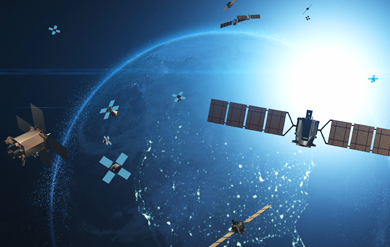
More than 10,000 active satellites now operate in LEO, and tens of thousands more could join them in the coming years. They're being used to provide broadband internet, connect aircraft and ships, support direct-to-device communications and monitor everything from weather and wildfires to crops and climate.

LEO satellites typically orbit from a few hundred to roughly 2,000 kilometers above Earth. That's certainly not close by everyday standards, but in space terms, they're practically our neighbors.

Their proximity is one of their biggest advantages. A radio signal traveling between Earth and a LEO satellite has a much shorter trip than one traveling to satellites in higher orbits. Shorter trips mean less delay—or latency—making LEO particularly attractive for broadband applications where people expect connections to feel almost instantaneous. 

Take a Deeper Dive
 

LEO_Satellites_Blog_Image.png


  • Explore the eBook LEO Satellites: Driving the Future
  • Watch our video “Connecting the World Through Space”
  • Read the technical article: How Modern LEO Satellite Technologies are Changing the Space Race

But that proximity comes with a catch: LEO satellites don't stay put. Instead, they race around Earth, typically completing an orbit in roughly 90 to 120 minutes. From the perspective of someone standing on the ground, a LEO satellite comes into view, travels across the sky and disappears over the horizon.

Think about making a phone call while driving down the highway. Your phone continually moves from one cell tower's coverage to the next, yet your conversation continues. LEO works on a similar principle with one important difference: instead of you moving past the towers, the "towers" are racing past you in space.

That's essentially the challenge facing a LEO satellite communications system.
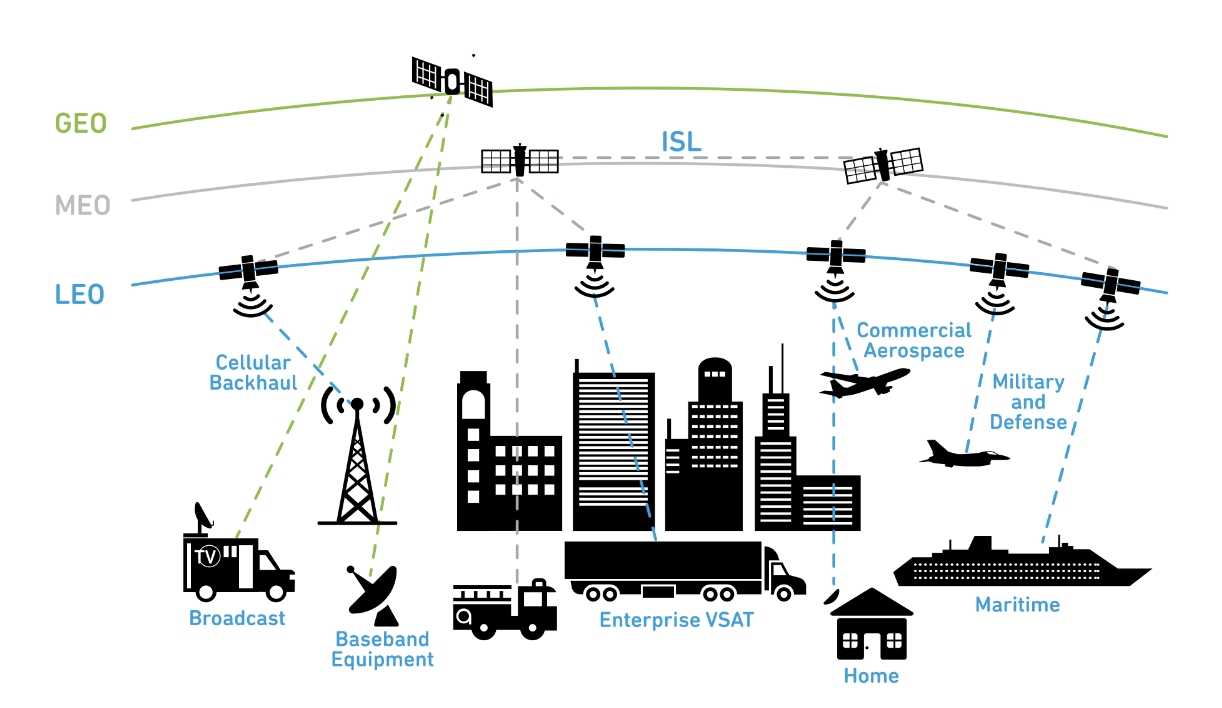
LEO mega-constellations are projected to provide a 100x increase in bandwidth over legacy GEO satellites, with latency reduced by 10x, while serving significantly more users.

Following a Satellite Without Moving the Antenna

Traditional satellite dishes often rely on physically pointing an antenna toward a satellite. That works well when the satellite is relatively stationary. But following a fast-moving LEO satellite and then quickly switching to another requires a more agile approach.

This is where solutions like electronically steered antennas and beamforming are essential.

Unlike a dish that physically turns, an Active electronically scanned array (AESA) antenna can change the direction of its signal electronically, without needing to move physically, offering a big improvement over the mechanically steered antennas’ agility. Rather than relying on one antenna element, it uses an array of many small elements working together. By carefully controlling the signals across those elements, the system can create a focused beam and rapidly change where it points. And it uses beamforming techniques for fast and accurate beam steering adjustments.

What is beamforming? Think of it as the RF equivalent of a flashlight. A bare light bulb spreads light in every direction. A flashlight concentrates that energy into a beam and points it where you need it. Beamforming does something similar with radio waves, focusing RF energy in a particular direction. This enables connectivity to satellites in any orbit with fast handoff between satellites.

As a LEO satellite moves across the sky, the beam can follow it electronically. When that satellite moves out of range, the system can establish a connection with another. The antenna barely seems to be doing anything. 

Electronically, however, there's a lot going on.

The Technology Behind the Beam

For LEO, the technology challenge is largely about enabling agility and efficiency: steer quickly, maintain the link, manage handoffs and do it within tight power and thermal budgets. That’s where Qorvo's beamformer ICs, RF front-end technologies and GaN power amplifiers come in. These technologies help designers address those requirements while balancing performance against size, weight, power consumption, thermal management and cost.

  • Beamformer ICs: aim the signal. An electronically steered antenna contains many small antenna elements. Qorvo's beamformer ICs accurately control the phase and amplitude of the RF signal going to those elements. By coordinating them, the antenna creates a focused beam and electronically points it toward a moving satellite. As the satellite moves, the beamformer continually adjusts the beam to follow it. 
  • RF front-end technologies: prepare and protect the signal integrity. The RF front end sits between the antenna and the rest of the radio. Components such as filters, switches and low-noise amplifiers help route signals, remove unwanted interference and amplify very weak incoming signals. Essentially, they help the system hear clearly and communicate cleanly. 
  • Power Amplifiers: give the outgoing signal a power boost. Before an RF signal is transmitted toward a satellite, it needs to be amplified. Power amplifiers can produce substantial RF power efficiently in a relatively small package. That's especially useful in satellite communications, where designers care about power consumption, heat, size and weight

Making Something Remarkably Complicated Feel Simple

Perhaps the most impressive thing about LEO satellite communications is how little the person using them needs to know about any of this. You don't need to know which satellite is overhead. You don't need to aim an antenna. You don't need to know when your connection moves from one satellite to another. You just expect the movie to keep playing, the video call to continue, and the data to arrive.

But it is fascinating to know that behind that simple experience is an extraordinarily choreographed RF performance: satellites racing around Earth, beams changing direction and signals traveling hundreds of miles through space. And when all that technology does its job well, the most remarkable part is that you never have to think about it.

For more information about Qorvo’s satellite communications technologies, go to our SATCOM page on Qorvo.com.


Stay up to date with us.

Sign up for notification on new products, product/process change notifications (PCNs) and end of life (EOL) alerts.

Sign Up

Qorvo products are at work connecting, protecting and powering the planet. We bring core radio frequency (RF) and power technologies and solutions to automotive, consumer, defense & aerospace, industrial & enterprise, infrastructure and mobile markets.

Stay Connected

  • Facebook
  • X
  • LinkedIn
  • YouTube
  • Products
  • Solutions
  • Design Hub
  • New Products
  • Product Compliance
  • Blog Posts
  • Events & Trade Shows
  • News Releases
  • Success Stories
  • Technical Articles
  • About Us
  • Careers
  • Corporate Videos
  • Quality
  • Locations
  • Investors
  • How to Buy
  • Forums
  • Portals
  • Contact Us
  • Subscription Center
Site MapFeedbackLegalPrivacySupply Chain Transparency

© 2026 Qorvo US, Inc

Cell Towers in the Sky: Inside the Technology Behind LEO

Blog PostOctober 1, 2026

It's 8 o’clock in the morning. Somewhere over the Atlantic, a passenger is streaming a movie at 35,000 feet. Hundreds of miles away, a crew member aboard a cargo ship is video calling home. In a remote mountain community, a student opens a laptop and joins an online class.

They may be thousands of miles apart, but they have something in common: their connection may be coming from a constellation of satellites overhead. 

Welcome to the increasingly busy world of low Earth orbit (LEO) satellites, which are, in essence, cell towers in the sky. While they certainly have their advantages, they also come with engineering challenges.

This post explores how LEO satellite networks operate and the sophisticated RF technologies that enable them to track, transmit and maintain reliable connections across constantly moving constellations.

LEO: The Neighborhood Just Above Ours

More than 10,000 active satellites now operate in LEO, and tens of thousands more could join them in the coming years. They're being used to provide broadband internet, connect aircraft and ships, support direct-to-device communications and monitor everything from weather and wildfires to crops and climate.

LEO satellites typically orbit from a few hundred to roughly 2,000 kilometers above Earth. That's certainly not close by everyday standards, but in space terms, they're practically our neighbors.

Their proximity is one of their biggest advantages. A radio signal traveling between Earth and a LEO satellite has a much shorter trip than one traveling to satellites in higher orbits. Shorter trips mean less delay—or latency—making LEO particularly attractive for broadband applications where people expect connections to feel almost instantaneous. 

Take a Deeper Dive


LEO_Satellites_Blog_Image.png


  • Explore the eBook LEO Satellites: Driving the Future
  • Watch our video “Connecting the World Through Space”
  • Read the technical article: How Modern LEO Satellite Technologies are Changing the Space Race

But that proximity comes with a catch: LEO satellites don't stay put. Instead, they race around Earth, typically completing an orbit in roughly 90 to 120 minutes. From the perspective of someone standing on the ground, a LEO satellite comes into view, travels across the sky and disappears over the horizon.

Think about making a phone call while driving down the highway. Your phone continually moves from one cell tower's coverage to the next, yet your conversation continues. LEO works on a similar principle with one important difference: instead of you moving past the towers, the "towers" are racing past you in space.

That's essentially the challenge facing a LEO satellite communications system.

LEO mega-constellations are projected to provide a 100x increase in bandwidth over legacy GEO satellites, with latency reduced by 10x, while serving significantly more users.

Following a Satellite Without Moving the Antenna

Traditional satellite dishes often rely on physically pointing an antenna toward a satellite. That works well when the satellite is relatively stationary. But following a fast-moving LEO satellite and then quickly switching to another requires a more agile approach.

This is where solutions like electronically steered antennas and beamforming are essential.

Unlike a dish that physically turns, an Active electronically scanned array (AESA) antenna can change the direction of its signal electronically, without needing to move physically, offering a big improvement over the mechanically steered antennas’ agility. Rather than relying on one antenna element, it uses an array of many small elements working together. By carefully controlling the signals across those elements, the system can create a focused beam and rapidly change where it points. And it uses beamforming techniques for fast and accurate beam steering adjustments.

What is beamforming? Think of it as the RF equivalent of a flashlight. A bare light bulb spreads light in every direction. A flashlight concentrates that energy into a beam and points it where you need it. Beamforming does something similar with radio waves, focusing RF energy in a particular direction. This enables connectivity to satellites in any orbit with fast handoff between satellites.

As a LEO satellite moves across the sky, the beam can follow it electronically. When that satellite moves out of range, the system can establish a connection with another. The antenna barely seems to be doing anything. 

Electronically, however, there's a lot going on.

The Technology Behind the Beam

For LEO, the technology challenge is largely about enabling agility and efficiency: steer quickly, maintain the link, manage handoffs and do it within tight power and thermal budgets. That’s where Qorvo's beamformer ICs, RF front-end technologies and GaN power amplifiers come in. These technologies help designers address those requirements while balancing performance against size, weight, power consumption, thermal management and cost.

  • Beamformer ICs: aim the signal. An electronically steered antenna contains many small antenna elements. Qorvo's beamformer ICs accurately control the phase and amplitude of the RF signal going to those elements. By coordinating them, the antenna creates a focused beam and electronically points it toward a moving satellite. As the satellite moves, the beamformer continually adjusts the beam to follow it. 
  • RF front-end technologies: prepare and protect the signal integrity. The RF front end sits between the antenna and the rest of the radio. Components such as filters, switches and low-noise amplifiers help route signals, remove unwanted interference and amplify very weak incoming signals. Essentially, they help the system hear clearly and communicate cleanly. 
  • Power Amplifiers: give the outgoing signal a power boost. Before an RF signal is transmitted toward a satellite, it needs to be amplified. Power amplifiers can produce substantial RF power efficiently in a relatively small package. That's especially useful in satellite communications, where designers care about power consumption, heat, size and weight

Making Something Remarkably Complicated Feel Simple

Perhaps the most impressive thing about LEO satellite communications is how little the person using them needs to know about any of this. You don't need to know which satellite is overhead. You don't need to aim an antenna. You don't need to know when your connection moves from one satellite to another. You just expect the movie to keep playing, the video call to continue, and the data to arrive.

But it is fascinating to know that behind that simple experience is an extraordinarily choreographed RF performance: satellites racing around Earth, beams changing direction and signals traveling hundreds of miles through space. And when all that technology does its job well, the most remarkable part is that you never have to think about it.

For more information about Qorvo’s satellite communications technologies, go to our SATCOM page on Qorvo.com.


Stay up to date with us.

Sign up for notification on new products, product/process change notifications (PCNs) and end of life (EOL) alerts.

Sign Up

Qorvo products are at work connecting, protecting and powering the planet. We bring core radio frequency (RF) and power technologies and solutions to automotive, consumer, defense & aerospace, industrial & enterprise, infrastructure and mobile markets.

Stay Connected

  • Facebook
  • X
  • LinkedIn
  • YouTube
  • Products
  • Solutions
  • Design Hub
  • New Products
  • Product Compliance
  • Blog Posts
  • Events & Trade Shows
  • News Releases
  • Success Stories
  • Technical Articles
  • About Us
  • Careers
  • Corporate Videos
  • Quality
  • Locations
  • Investors
  • How to Buy
  • Forums
  • Portals
  • Contact Us
  • Subscription Center
Site MapFeedbackLegalPrivacySupply Chain Transparency

© 2026 Qorvo US, Inc

Qorvo
  • Products
  • Solutions
  • Design Hub
  • Support
  • About Us
Qorvo AI
Qorvo
Qorvo AI
Qorvo
Qorvo
  • Products
  • Solutions
  • Design Hub
  • Support
  • About Us
Qorvo AI
Qorvo
Qorvo AI
Qorvo