Enabling 10 Gbps Cable Networks with Full Duplex DOCSIS 3.1
 5G is the buzz word of the year for mobile devices and cellular infrastructure — but cable TV infrastructure is doing its part to upgrade its system capacity and support the transition to 5G.
One breakthrough CATV technology currently in development is Full Duplex DOCSIS 3.1, which will significantly increase the upstream capabilities of existing hybrid fiber-coaxial (HFC) cable networks. What is Full Duplex DOCSIS? How is it different from DOCSIS 3.1 technology deployed today? What are the challenges of this new standard? Let's explore.
The state of DOCSIS 3.1 today
DOCSIS (or Data Over Cable Service Interface Specification) originated in the late 1990s when the cable industry moved from an analog to a digital transmission system. DOCSIS 1.0 allowed a digital signal to transmit over existing analog coaxial cable systems, and subsequent releases of the DOCSIS specification have brought increased data speeds and capabilities to the system, as shown in the following table.
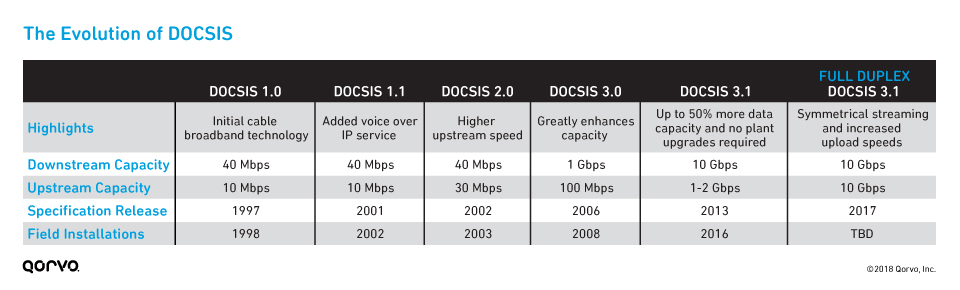
A number of MSOs in the U.S., including Comcast, Mediacom and Midco, have already deployed DOCSIS 3.1 to multiple cities, and 2018 will likely see even more deployments across more MSOs.
The move to Full Duplex DOCSIS 3.1
Even with the latest DOCSIS 3.1, the upstream capacity of the cable industry’s HFC network likely isn’t sufficient in the long run. The goal is to achieve 10 Gbps symmetrical streaming — or 10 Gbps bidirectionally, downstream and upstream — for several reasons:
- Competing technologies, such as fiber, can already hit 10 Gbps symmetrically. CATV operators need to achieve 10 Gbps upstream to remain competitive with Google Fiber, fiber to the home (FTTH) and passive optical networks (PONs), which can already transmit 10 Gbps upstream.
- Emerging applications will demand faster upstream and downstream speeds. Current upstream capacity is probably sufficient for the use cases existing today, such as streaming videos or Facebook Live. But cable networks will need to significantly increase their upstream capacity to support new user experiences and those of the future, such as virtual reality, autonomous cars, sensor networks, connected smart homes and others. These new use cases will exponentially increase the amount of data being transmitted upstream and downstream.
- Cable and fiber networks need to support the growing bandwidth and data requirements of 5G. As cellular networks upgrade to 5G over the coming years, cable and fiber networks will also need to increase their capacity to help the overall infrastructure support 5G.
The most challenging problem is that it’s expensive to tear up existing coaxial cable or upgrade the head end. Instead, cable MSOs want to make their existing copper coaxial networks last longer and are looking for alternative ways to increase the bandwidth of cable networks. Full Duplex (FDX) DOCSIS is their answer.
Full Duplex DOCSIS is an extension of the DOCSIS 3.1 specification that significantly increases upstream capacity and allows cable MSOs to achieve 10 Gbps speeds downstream and upstream.
Cisco and Intel had proof-of-concept demos at ANGA COM and SCTE in the spring and fall of 2017 to show that FDX is possible, and CableLabs released the final Full Duplex DOCSIS 3.1 specification in October 2017. Since then, suppliers are feverishly working to develop nodes and modems to support FDX, with the first FDX nodes due to Comcast this summer for initial trials. We should start seeing field trials from some MSOs in late 2018 or early 2019, and the first North American commercial deployments of FDX in 2019.
Glossary of Terms
- ACPR: adjacent channel power ratio
- CATV: cable TV
- DOCSIS: Data Over Cable Service Interface Specification
- DPD: digital predistortion
- FDD: frequency division duplexing
- FDX: full duplex
- FTTH: fiber to the home
- HFC: hybrid fiber-coaxial
- MER: modulation error ratio
- MSO: multiple system operator
- PHY: physical layer
- PON: passive optical network
- RFoG: RF over glass
- RPD: remote PHY device
- RPHY: remote PHY
FDD today, FDX tomorrow
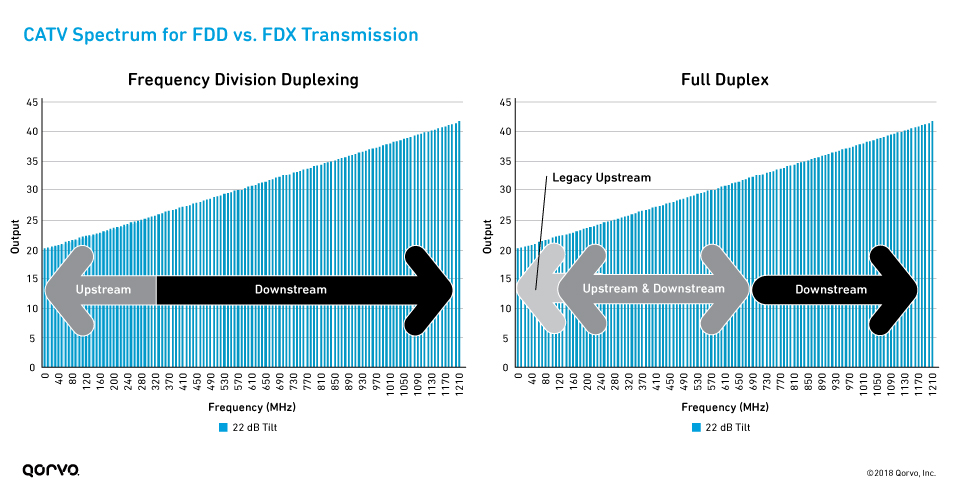
The cable system transmits every frequency in a solid band, from 50 MHz to 1.2 GHz. Since the 1970s, the CATV network has used frequency division duplexing (FDD), where the spectrum is split between upstream and downstream data transmission. In FDD, upstream and downstream signals don’t interfere since they don’t overlap, as shown in the following figure.
To achieve full 10 Gbps symmetrical streaming, the cable system must change from FDD to full duplex. In FDX DOCSIS, MSOs can use the full spectrum for upstream and downstream transmissions, in both directions at the same time, with overlapping transmissions at some frequencies.
Addressing the RF challenges of DOCSIS FDX
Achieving full-duplex symmetrical streaming faces many challenges. Let’s examine some of the biggest ones.
- Fiber deep networks. As a first step, cable operators are moving more functions from the head end out to the field. Head ends are large and expensive, with huge capital expenses and upkeep. To achieve FDX and keep costs down, MSOs will push fiber cables deeper in the network, migrating to N+0 networks with digital remote PHY nodes. In a fiber deep network, there’s only one amplifier, in the node; no additional amplifier follows it. For FDX to work, a lot of technology still must be invented and upgraded in the remote PHY node, such as echo cancellation, couplers and other intricate parts of the node.
- Higher composite output power. The composite power increases when using FDX, to support tilt, echo cancellation and other requirements. For DOCSIS 3.1 remote PHY fiber deep applications today, the amplifier output requirement is 76.8 dBmV. The challenge is that this exceeds what most amplifiers on the market today are capable of.
- Echo cancellation. Imagine if you were yelling at the top of your lungs, while somebody across the street is whispering to you. At the same time, you’re in an urban canyon with echoes that are even louder than the whisper. This essentially is the challenge with FDX DOCSIS 3.1. The cable remote PHY node must cancel out all the echoes, ignore what it’s shouting (the downstream transmitted signal), and listen for the faint receiving signal from the upstream transmission.
Echo cancellation is one of the biggest challenges for FDX. It will require some very sophisticated digital signal processing (DSP) that currently isn’t in the node, which will also increase the node’s processing power requirements. Combined, the processing power for echo cancellation adds a few watts of power.
It’s a race to develop a component that meets the DC power targets and gets the echo cancellation technology right.
- Modulation error ratio (MER). The biggest RF challenge for FDX is MER, which measures how spread out the symbol points in a constellation are and thus the error present in the modulation. MER includes the effects of all discrete spurious noise, carrier leakage, clock lines, synthesizer products, linear and nonlinear distortions, other undesired transmitter and receiver products, ingress, and similar in-channel impairments. Essentially, the challenge for FDX is trying to get a lot of RF power with very little DC power and very few errors (low MER).
- Digital predistortion (DPD). DPD is used to increase the efficiency of the power amplifier. DPD algorithms predict the nonlinear behavior of the amplifier, correct for it and save power from the amplifier so you can have a remote PHY and node+0. To do FDX, devices will need to be optimized for DPD. Employing DPD algorithms will bring higher efficiency, better ACPR (linearity) and better MER, as well as lower operational and cable provider costs.
Qorvo’s FDX-ready product offerings
Full Duplex DOCSIS is a complex space, but Qorvo is working hand-in-hand with many customers to develop components and solutions that meet the rigorous requirements of FDX. Here are some of our featured product offerings to support Full Duplex DOCSIS.
Higher composite output power: Qorvo RFPD3580 hybrid GaN amplifier
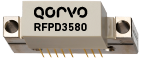
Qorvo is currently the only supplier in full production with an amplifier that provides the highest 76.8 dBmV composite output power, with our RFPD3580 hybrid GaN CATV amplifier.
Optimized for digital predistortion (DPD): QPA3250 hybrid power doubler
DPD is used in many of our wireless devices, but the technology isn’t as common in CATV. We’re working with key DPD developers to optimize our RF solutions in CATV devices — such as the QPA3250, a hybrid power doubler amplifier that is optimized for DPD in FDX. These devices will enable the same MER and output power but at a lower current. The QPA3250 will be released in late 2018.
Plug-and-play single component for tilt: QPC7336 DOCSIS 3.1 variable equalizer
The circuit that puts the tilt on the signal is called the equalizer. Today, in most nodes, a plastic plug-in module plugged applies the required tilt. Unfortunately, this isn't always ideal because the tilt value is fixed (e.g., 10 dB).
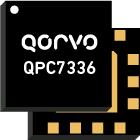
In contrast, our QPC7336 uses the latest silicon on insulator (SOI) technology, providing ranges of the desired tilt. The QPC7336 is capable of a tilt range 5-15 dB, which can be controlled using a microcontroller and a DAC (digital-to-analog converter).
In most HFC systems, tilt is usually set in two stages in the amplifier. By using two of our devices in a socket, cable operators have the flexibility to change the tilt remotely, without having to send a repair truck to a physical location. It’s an innovative approach, and we’re proud to have one of the few solutions for this technology.
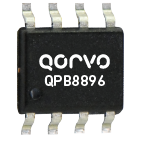
FDX-ready reverse amplifier: QPB8896 balanced return path amplifier
In addition to our solutions for downstream transmissions, we also have the QPB8896, an FDX-ready reverse amplifier that supports 5-700 MHz FDX upstream transmissions. This amplifier features very low noise and high gain, and it will be available in mid-2018.
FDX: A race to get it right
Full Duplex DOCSIS 3.1 faces a number of challenges in development and deployment, but it’s an exciting time in the industry. The cable manufacturers are working directly with RF providers, including Qorvo, to help decrease the overall DC power, increase overall RF power, and design custom solutions.
To learn more about Qorvo's solutions for DOCSIS 3.1 and Full Duplex, download our CATV Product Selection Guide or view details for the products mentioned in this blog post:
Qorvo CATV Product Selection Guide

View our best-in-class, end-to-end Broadband and CATV solutions.