The Invisible Journey of Every Signal in Your Home

Blog PostNovember 2, 2026

Imagine it's a typical evening.

Someone is streaming a movie in the living room. A teenager is gaming upstairs. A security camera is uploading video clips to the cloud. A smart speaker is playing music in the kitchen. The thermostat is checking weather data online while a robot vacuum quietly maps the floor.

None of these devices know—or care—what the others are doing.

Yet somehow, everything works.

Most homeowners rarely think about what makes this possible. But behind every connected home is a complex network of wireless signals, power systems and communication technologies working together to keep devices connected, responsive and efficient. And as homes become increasingly connected, that challenge grows more difficult every day.

A House Full of Signals

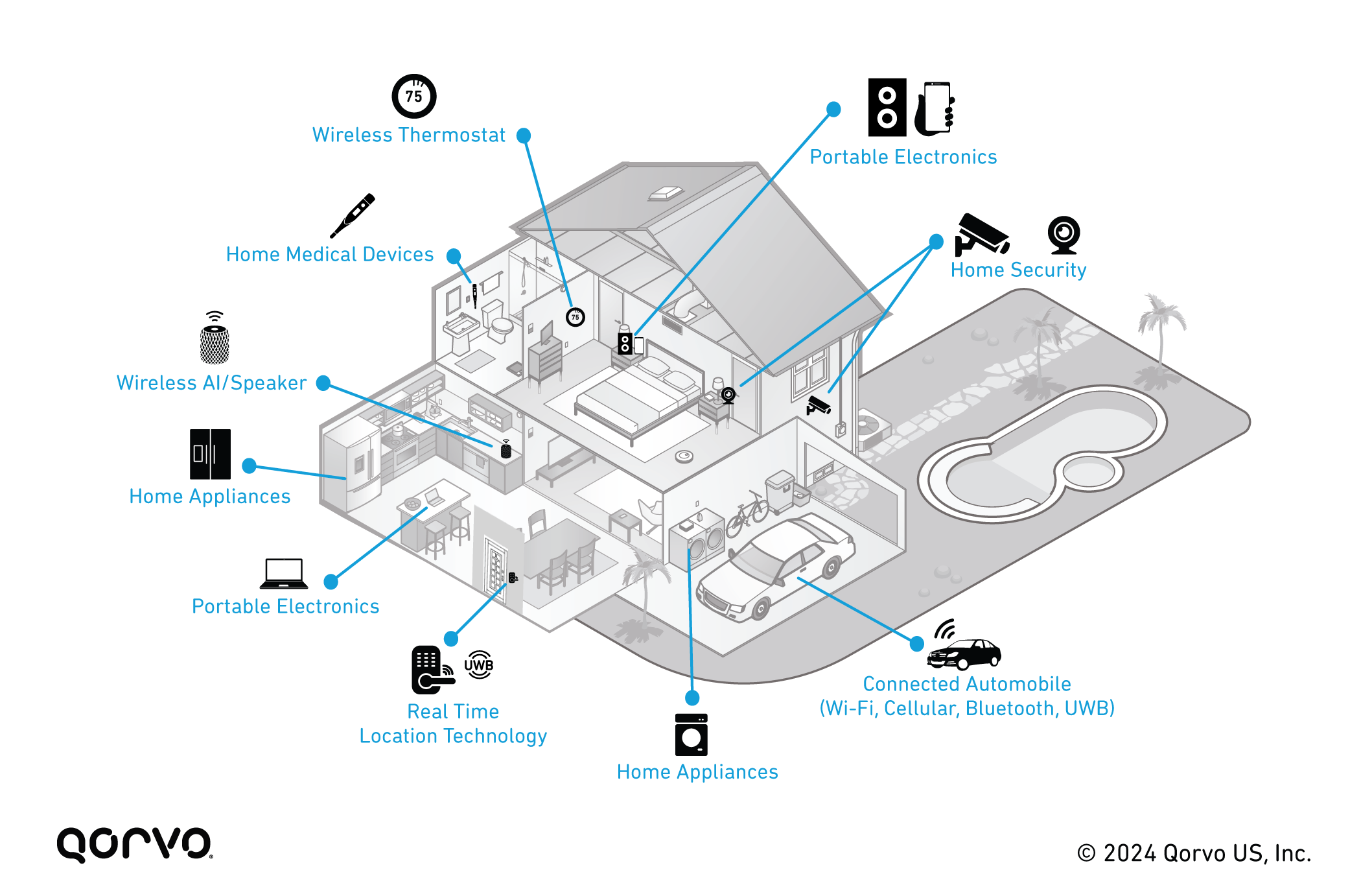
Not long ago, the average home had a handful of connected devices. Today, many homes contain dozens. Wi-Fi routers, smart TVs, streaming devices, smart speakers, security cameras, thermostats, smart appliances, doorbell cameras, tablets, smartphones, wearables and countless sensors all compete for wireless connectivity. Every one of those devices is constantly sending, receiving or waiting for information.


Take a Deeper Dive
 

Home_Networking_Blog_Image_2.png
  • Read our eBooks to learn more about:
    • Internet of Things
    • RF Filters
  • Learn about the promises of Wi-Fi 8
  • Peruse our BAW Filters for Wi-Fi Brochure
 

WR168_-_Image_2.png

The challenge isn't simply creating a wireless signal. The challenge is ensuring that signal arrives clearly and reliably in an environment that becomes more crowded every year.

Think about a busy restaurant. Having a conversation with someone across the table is easy when the room is quiet. As more people arrive and the noise level rises, hearing the person you're talking to becomes more difficult.

Wireless communication faces a similar challenge. As more devices compete for spectrum, signals can interfere with one another, reducing performance and reliability. Keeping communication clear requires far more engineering than most people realize.This is where technology like Qorvo’s works behind the scenes, acting as air traffic control at a busy airport to help dozens of signals safely reach the right destination at the right time by ensuring timing and  there is no interference on the runway. 

This is where technology like Qorvo’s works behind the scenes, acting as air traffic control at a busy airport to help dozens of signals safely reach the right destination while ensuring timing and minimizing interference. Just as controllers coordinate aircraft and keep runways clear of potential interference, such as other planes and service vehicles to birds, RF technologies help signals reach the right destination at the right time without disruption. Here, we explore the technologies that make it all work.

Not Every Signal Belongs

Before information can travel through a wireless device, engineers must ensure the device can distinguish the signals it wants from the countless signals it doesn't.

That's where RF filtering comes into play.

RF filtersare specialized semiconductor components that act like bouncers at a crowded concert. Their job is to allow the wireless signals you want to pass through while blocking signals you don't, enabling devices to focus on the information that matters and ignore the surrounding noise. Without effective filtering, wireless performance would quickly degrade as homes fill with more connected devices operating across multiple frequency bands.

Whether it's a video doorbell sending an alert, a smart speaker responding to a question or a router handling dozens of simultaneous connections, signal quality starts with ensuring the right signals make it through.

Giving Signals the Strength to Travel

Once a signal has been isolated, it still faces another challenge: getting where it needs to go. Walls, distance, building materials and competing devices can all weaken wireless communication. That's why connected devices rely on sophisticated RF front-end technologies designed to strengthen desired signals and improve communication reliability.

Power amplifiers (PAs) help boost outbound signals so information can travel farther and more effectively. A PA is a bit like a megaphone for wireless signals. The information is already there, but before the signal leaves a router, smart speaker or connected device, the amplifier boosts its strength so it can travel farther and arrive more reliably. Without power amplifiers, many of the wireless connections we take for granted would struggle to reach across our homes.

Low-noise amplifiers (LNAs)  help devices detect weak incoming signals that might otherwise be lost. If power amplifiers are the megaphones of the wireless world, low-noise amplifiers are the hearing aids. By the time a signal reaches a router or connected device, it may have traveled through walls, floors and long distances, becoming increasingly weak along the way. Low-noise amplifiers help devices detect and strengthen these faint incoming signals while minimizing additional interference. The result is more reliable communication, greater coverage and fewer dropped connections throughout the home.

Together, these technologies help improve:

  • Wi-Fi coverage
  • Data throughput
  • Connection reliability
  • Streaming performance
  • Device responsiveness

Consumers may never see these components, but they experience the benefits every day when devices remain connected and perform as expected.

The Power Behind Every Connection

Strong signals alone aren't enough. Every connected device also requires power—and lots of it.

Home networking equipment often operates around the clock. Routers run continuously. Security systems remain active day and night. Sensors wait patiently for activity. Smart appliances stay ready for commands. All of that connectivity requires energy.

As the number of connected devices grows, engineers face an increasingly important challenge: delivering performance while minimizing power consumption. Consumers want devices that are always available, but they also want lower energy bills, longer battery life and less heat generation. Balancing those competing priorities requires intelligent power management.

Inside many connected devices, Power Management Integrated Circuits (PMICs) help regulate and distribute power throughout the system.

Think of them as traffic controllers for energy.

They ensure that processors, wireless radios, sensors and memory components receive the power they need when they need it, and conserve energy when they don't.

Rather than operating every component at full power all the time, modern devices can intelligently place portions of the system into low-power states until they are needed again.

This approach helps reduce:

  • Energy waste
  • Heat generation
  • Standby power consumption
  • Battery drain

The result is a device that remains responsive while consuming less energy over its lifetime.

Building the Future of Connected Homes

The connected home continues to evolve. New applications are emerging for security, entertainment, energy management, health monitoring and home automation. Artificial intelligence is also beginning to make homes more adaptive and responsive to their occupants.

As more devices come online, maintaining reliable communication becomes increasingly important. The future of home networking won't simply depend on faster wireless standards or more connected devices. It will depend on technologies that improve signal quality, reduce interference, strengthen connectivity and manage power more efficiently.

Because every smart home relies on something surprisingly simple: information moving from one place to another. And behind every successful connection is an invisible journey powered by advanced RF and power technologies working together to keep the modern home connected.

Stay up to date with us.

Sign up for notification on new products, product/process change notifications (PCNs) and end of life (EOL) alerts.

Sign Up

Qorvo products are at work connecting, protecting and powering the planet. We bring core radio frequency (RF) and power technologies and solutions to automotive, consumer, defense & aerospace, industrial & enterprise, infrastructure and mobile markets.

Stay Connected

  • Facebook
  • X
  • LinkedIn
  • YouTube
  • Products
  • Solutions
  • Design Hub
  • New Products
  • Product Compliance
  • Blog Posts
  • Events & Trade Shows
  • News Releases
  • Success Stories
  • Technical Articles
  • About Us
  • Careers
  • Corporate Videos
  • Quality
  • Locations
  • Investors
  • How to Buy
  • Forums
  • Portals
  • Contact Us
  • Subscription Center
Site MapFeedbackLegalPrivacySupply Chain Transparency

© 2026 Qorvo US, Inc

The Invisible Journey of Every Signal in Your Home

Blog PostNovember 2, 2026

Imagine it's a typical evening.

Someone is streaming a movie in the living room. A teenager is gaming upstairs. A security camera is uploading video clips to the cloud. A smart speaker is playing music in the kitchen. The thermostat is checking weather data online while a robot vacuum quietly maps the floor.

None of these devices know—or care—what the others are doing.

Yet somehow, everything works.

Most homeowners rarely think about what makes this possible. But behind every connected home is a complex network of wireless signals, power systems and communication technologies working together to keep devices connected, responsive and efficient. And as homes become increasingly connected, that challenge grows more difficult every day.

A House Full of Signals

Not long ago, the average home had a handful of connected devices. Today, many homes contain dozens. Wi-Fi routers, smart TVs, streaming devices, smart speakers, security cameras, thermostats, smart appliances, doorbell cameras, tablets, smartphones, wearables and countless sensors all compete for wireless connectivity. Every one of those devices is constantly sending, receiving or waiting for information.


Take a Deeper Dive


Home_Networking_Blog_Image_2.png
  • Read our eBooks to learn more about:
    • Internet of Things
    • RF Filters
  • Learn about the promises of Wi-Fi 8
  • Peruse our BAW Filters for Wi-Fi Brochure


WR168_-_Image_2.png

The challenge isn't simply creating a wireless signal. The challenge is ensuring that signal arrives clearly and reliably in an environment that becomes more crowded every year.

Think about a busy restaurant. Having a conversation with someone across the table is easy when the room is quiet. As more people arrive and the noise level rises, hearing the person you're talking to becomes more difficult.

Wireless communication faces a similar challenge. As more devices compete for spectrum, signals can interfere with one another, reducing performance and reliability. Keeping communication clear requires far more engineering than most people realize.This is where technology like Qorvo’s works behind the scenes, acting as air traffic control at a busy airport to help dozens of signals safely reach the right destination at the right time by ensuring timing and  there is no interference on the runway. 

This is where technology like Qorvo’s works behind the scenes, acting as air traffic control at a busy airport to help dozens of signals safely reach the right destination while ensuring timing and minimizing interference. Just as controllers coordinate aircraft and keep runways clear of potential interference, such as other planes and service vehicles to birds, RF technologies help signals reach the right destination at the right time without disruption. Here, we explore the technologies that make it all work.

Not Every Signal Belongs

Before information can travel through a wireless device, engineers must ensure the device can distinguish the signals it wants from the countless signals it doesn't.

That's where RF filtering comes into play.

RF filtersare specialized semiconductor components that act like bouncers at a crowded concert. Their job is to allow the wireless signals you want to pass through while blocking signals you don't, enabling devices to focus on the information that matters and ignore the surrounding noise. Without effective filtering, wireless performance would quickly degrade as homes fill with more connected devices operating across multiple frequency bands.

Whether it's a video doorbell sending an alert, a smart speaker responding to a question or a router handling dozens of simultaneous connections, signal quality starts with ensuring the right signals make it through.

Giving Signals the Strength to Travel

Once a signal has been isolated, it still faces another challenge: getting where it needs to go. Walls, distance, building materials and competing devices can all weaken wireless communication. That's why connected devices rely on sophisticated RF front-end technologies designed to strengthen desired signals and improve communication reliability.

Power amplifiers (PAs) help boost outbound signals so information can travel farther and more effectively. A PA is a bit like a megaphone for wireless signals. The information is already there, but before the signal leaves a router, smart speaker or connected device, the amplifier boosts its strength so it can travel farther and arrive more reliably. Without power amplifiers, many of the wireless connections we take for granted would struggle to reach across our homes.

Low-noise amplifiers (LNAs)  help devices detect weak incoming signals that might otherwise be lost. If power amplifiers are the megaphones of the wireless world, low-noise amplifiers are the hearing aids. By the time a signal reaches a router or connected device, it may have traveled through walls, floors and long distances, becoming increasingly weak along the way. Low-noise amplifiers help devices detect and strengthen these faint incoming signals while minimizing additional interference. The result is more reliable communication, greater coverage and fewer dropped connections throughout the home.

Together, these technologies help improve:

  • Wi-Fi coverage
  • Data throughput
  • Connection reliability
  • Streaming performance
  • Device responsiveness

Consumers may never see these components, but they experience the benefits every day when devices remain connected and perform as expected.

The Power Behind Every Connection

Strong signals alone aren't enough. Every connected device also requires power—and lots of it.

Home networking equipment often operates around the clock. Routers run continuously. Security systems remain active day and night. Sensors wait patiently for activity. Smart appliances stay ready for commands. All of that connectivity requires energy.

As the number of connected devices grows, engineers face an increasingly important challenge: delivering performance while minimizing power consumption. Consumers want devices that are always available, but they also want lower energy bills, longer battery life and less heat generation. Balancing those competing priorities requires intelligent power management.

Inside many connected devices, Power Management Integrated Circuits (PMICs) help regulate and distribute power throughout the system.

Think of them as traffic controllers for energy.

They ensure that processors, wireless radios, sensors and memory components receive the power they need when they need it, and conserve energy when they don't.

Rather than operating every component at full power all the time, modern devices can intelligently place portions of the system into low-power states until they are needed again.

This approach helps reduce:

  • Energy waste
  • Heat generation
  • Standby power consumption
  • Battery drain

The result is a device that remains responsive while consuming less energy over its lifetime.

Building the Future of Connected Homes

The connected home continues to evolve. New applications are emerging for security, entertainment, energy management, health monitoring and home automation. Artificial intelligence is also beginning to make homes more adaptive and responsive to their occupants.

As more devices come online, maintaining reliable communication becomes increasingly important. The future of home networking won't simply depend on faster wireless standards or more connected devices. It will depend on technologies that improve signal quality, reduce interference, strengthen connectivity and manage power more efficiently.

Because every smart home relies on something surprisingly simple: information moving from one place to another. And behind every successful connection is an invisible journey powered by advanced RF and power technologies working together to keep the modern home connected.

Stay up to date with us.

Sign up for notification on new products, product/process change notifications (PCNs) and end of life (EOL) alerts.

Sign Up

Qorvo products are at work connecting, protecting and powering the planet. We bring core radio frequency (RF) and power technologies and solutions to automotive, consumer, defense & aerospace, industrial & enterprise, infrastructure and mobile markets.

Stay Connected

  • Facebook
  • X
  • LinkedIn
  • YouTube
  • Products
  • Solutions
  • Design Hub
  • New Products
  • Product Compliance
  • Blog Posts
  • Events & Trade Shows
  • News Releases
  • Success Stories
  • Technical Articles
  • About Us
  • Careers
  • Corporate Videos
  • Quality
  • Locations
  • Investors
  • How to Buy
  • Forums
  • Portals
  • Contact Us
  • Subscription Center
Site MapFeedbackLegalPrivacySupply Chain Transparency

© 2026 Qorvo US, Inc

Qorvo, part of Skyworks
  • Products
  • Solutions
  • Design Hub
  • Support
  • About Us
Qorvo AI
Qorvo, part of Skyworks
Qorvo AI
Qorvo, part of Skyworks
  • Products
  • Solutions
  • Design Hub
  • Support
  • About Us
Qorvo AI
Qorvo, part of Skyworks
Qorvo AI
Qorvo, part of Skyworks