Power Class 2: What You Need to Know

March 6, 2017

RF engineers are continually challenged when designing RF front-ends for mobile devices. A higher number of frequency bands (up to 40), including Wi-Fi and Bluetooth, jammed into one device; fewer SKUs (stock keeping units) — all can make design tricky. In some cases, difficult coexistence requirements can go from being a minor inconvenience to a nightmare. And that's before designing for new standards, such as Power Class 2.

Power Class 2: A New Standard for TD-LTE

Power Class 2 is a new LTE power standard that gained 3GPP certification in December 2016, as part of an industry initiative to add high-performance user equipment (HPUE) and improve 2.5 GHz LTE TDD coverage worldwide. Higher frequency signals can't travel as far, so cellular carriers needed a way to achieve higher power output. Power Class 2 was the answer.

Initially, the 3GPP spec for Power Class 3, the previous standard, limited mobile-to-tower uplink of Band 41 to 23 dBm nominal output power. This definition helped ensure backward compatibility with prior technologies (GSM/UMTS) so that network deployment topologies could remain similar.

Go in Depth
Learn more about HPUE and Power Class 2:

  • Breakthrough HPUE Innovation to Benefit TDD-LTE Networks Worldwide, Sprint, 12/13/2016
  • 3GPP spec v.14.0:
    E-UTRA – Band 41 High Power UE (HPUE), TR 36.886 (RAN4), 6/2016

However, TDD-LTE Band 41 does not have any 3GPP legacy technologies associated with it, so it does not have to be backward compatible. This allowed the 3GPP to define a new power standard — Power Class 2 — and increase the power output for TDD Band 41.

Power Class 2 allows for output power levels of 26 dBm — double the maximum output power previously defined by Power Class 3. (See the figure below.)
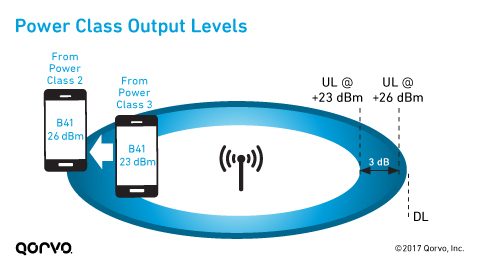
Power Class Output Levels

The increase in output power to Power Class 2 compensates for greater propagation losses at the higher TDD frequencies, enabling carriers to maintain cell coverage without adding expensive infrastructure. This is a win-win for both the user experience and the carriers — but it's a challenge for device manufacturers.

The RF Challenge

As RF front-end complexity grows, the overall insertion loss link budget increases. Designing using traditional discrete components and redundant matching only adds to the link budget. The new Power Class 2 requirement (i.e., output power to 26 dBm) further complicates the RF design.

When designing their front-ends, RF engineers need to use the following:

  • The best possible link budget to meet the new 26 dBm Power Class 2 standard
  • Design techniques and components to counteract the year-over-year increases in insertion loss (see the figure below)
  • The best filters to mitigate RF coexistence issues

RF Front-End Insertion Loss vs. Antenna Power

But there's good news. From the RF front-end module perspective, analysis shows that TDD B41 at 26 dBm actually improves the PA contribution to battery life. There is also up to 30% improvement in cell coverage in B41 TD-LTE with a single carrier.

How Qorvo Approaches Power Class 2

As RF design engineers, we must work to reduce these matching losses and system link budgets as much as possible. Qorvo uses two strategies to achieve this:

  • Integrated modules: High-performance, highly integrated RF modules such as Qorvo's RF Flex™ and RF Fusion™ allow direct matching between filters, switches and PAs, which can reduce the matching loss for both the Tx and Rx paths by as much as 0.5 dB. This helps the designer get closer to the goal of 26 dBm output without placing the full burden on the PA output alone.

RF Fusion™ High Band LTE Module

  • Premium filter technology: RF filters that mitigate coexistence issues introduce insertion loss to the system design. The filtering challenge is to pass the desired signals while attenuating undesired spectral components. Qorvo's BAW filter technology provides greater filter attenuation and superior filter insertion loss, which are required to avoid interference and optimize B41 link budgets.

Filter Response of Wi-Fi Bandpass Filter in Duplexer Module

Power Class 2 and Beyond

RF front-end design will continue to get more difficult as bands increase, frequencies go higher, and capacity solutions like carrier aggregation expand. Power Class 2 is a challenge, but one an RF engineer can meet if partnering with the most knowledgeable RF suppliers. Using high-performance Qorvo BAW filter technology and a highly integrated design approach like RF Flex and RF Fusion will help handset designers be more efficient and successful in a shorter amount of time.

Stay up to date with us.

Sign up for notification on new products, product/process change notifications (PCNs) and end of life (EOL) alerts.

Sign Up

Qorvo products are at work connecting, protecting and powering the planet. We bring core radio frequency (RF) and power technologies and solutions to automotive, consumer, defense & aerospace, industrial & enterprise, infrastructure and mobile markets.

Stay Connected

  • Facebook
  • X
  • LinkedIn
  • YouTube
  • Products
  • Solutions
  • Design Hub
  • New Products
  • Product Compliance
  • Blog Posts
  • Events & Trade Shows
  • News Releases
  • Success Stories
  • Technical Articles
  • About Us
  • Careers
  • Corporate Videos
  • Quality
  • Locations
  • Investors
  • How to Buy
  • Forums
  • Portals
  • Contact Us
  • Subscription Center
Site MapFeedbackLegalPrivacySupply Chain Transparency

© 2026 Qorvo US, Inc

|

+1-833-641-3810

Power Class 2: What You Need to Know

March 6, 2017

RF engineers are continually challenged when designing RF front-ends for mobile devices. A higher number of frequency bands (up to 40), including Wi-Fi and Bluetooth, jammed into one device; fewer SKUs (stock keeping units) — all can make design tricky. In some cases, difficult coexistence requirements can go from being a minor inconvenience to a nightmare. And that's before designing for new standards, such as Power Class 2.

Power Class 2: A New Standard for TD-LTE

Power Class 2 is a new LTE power standard that gained 3GPP certification in December 2016, as part of an industry initiative to add high-performance user equipment (HPUE) and improve 2.5 GHz LTE TDD coverage worldwide. Higher frequency signals can't travel as far, so cellular carriers needed a way to achieve higher power output. Power Class 2 was the answer.

Initially, the 3GPP spec for Power Class 3, the previous standard, limited mobile-to-tower uplink of Band 41 to 23 dBm nominal output power. This definition helped ensure backward compatibility with prior technologies (GSM/UMTS) so that network deployment topologies could remain similar.

Go in Depth
Learn more about HPUE and Power Class 2:

  • Breakthrough HPUE Innovation to Benefit TDD-LTE Networks Worldwide, Sprint, 12/13/2016
  • 3GPP spec v.14.0:
    E-UTRA – Band 41 High Power UE (HPUE), TR 36.886 (RAN4), 6/2016

However, TDD-LTE Band 41 does not have any 3GPP legacy technologies associated with it, so it does not have to be backward compatible. This allowed the 3GPP to define a new power standard — Power Class 2 — and increase the power output for TDD Band 41.

Power Class 2 allows for output power levels of 26 dBm — double the maximum output power previously defined by Power Class 3. (See the figure below.)

Power Class Output Levels

The increase in output power to Power Class 2 compensates for greater propagation losses at the higher TDD frequencies, enabling carriers to maintain cell coverage without adding expensive infrastructure. This is a win-win for both the user experience and the carriers — but it's a challenge for device manufacturers.

The RF Challenge

As RF front-end complexity grows, the overall insertion loss link budget increases. Designing using traditional discrete components and redundant matching only adds to the link budget. The new Power Class 2 requirement (i.e., output power to 26 dBm) further complicates the RF design.

When designing their front-ends, RF engineers need to use the following:

  • The best possible link budget to meet the new 26 dBm Power Class 2 standard
  • Design techniques and components to counteract the year-over-year increases in insertion loss (see the figure below)
  • The best filters to mitigate RF coexistence issues

RF Front-End Insertion Loss vs. Antenna Power

But there's good news. From the RF front-end module perspective, analysis shows that TDD B41 at 26 dBm actually improves the PA contribution to battery life. There is also up to 30% improvement in cell coverage in B41 TD-LTE with a single carrier.

How Qorvo Approaches Power Class 2

As RF design engineers, we must work to reduce these matching losses and system link budgets as much as possible. Qorvo uses two strategies to achieve this:

  • Integrated modules: High-performance, highly integrated RF modules such as Qorvo's RF Flex™ and RF Fusion™ allow direct matching between filters, switches and PAs, which can reduce the matching loss for both the Tx and Rx paths by as much as 0.5 dB. This helps the designer get closer to the goal of 26 dBm output without placing the full burden on the PA output alone.

RF Fusion™ High Band LTE Module

  • Premium filter technology: RF filters that mitigate coexistence issues introduce insertion loss to the system design. The filtering challenge is to pass the desired signals while attenuating undesired spectral components. Qorvo's BAW filter technology provides greater filter attenuation and superior filter insertion loss, which are required to avoid interference and optimize B41 link budgets.

Filter Response of Wi-Fi Bandpass Filter in Duplexer Module

Power Class 2 and Beyond

RF front-end design will continue to get more difficult as bands increase, frequencies go higher, and capacity solutions like carrier aggregation expand. Power Class 2 is a challenge, but one an RF engineer can meet if partnering with the most knowledgeable RF suppliers. Using high-performance Qorvo BAW filter technology and a highly integrated design approach like RF Flex and RF Fusion will help handset designers be more efficient and successful in a shorter amount of time.

Stay up to date with us.

Sign up for notification on new products, product/process change notifications (PCNs) and end of life (EOL) alerts.

Sign Up

Qorvo products are at work connecting, protecting and powering the planet. We bring core radio frequency (RF) and power technologies and solutions to automotive, consumer, defense & aerospace, industrial & enterprise, infrastructure and mobile markets.

Stay Connected

  • Facebook
  • X
  • LinkedIn
  • YouTube
  • Products
  • Solutions
  • Design Hub
  • New Products
  • Product Compliance
  • Blog Posts
  • Events & Trade Shows
  • News Releases
  • Success Stories
  • Technical Articles
  • About Us
  • Careers
  • Corporate Videos
  • Quality
  • Locations
  • Investors
  • How to Buy
  • Forums
  • Portals
  • Contact Us
  • Subscription Center
Site MapFeedbackLegalPrivacySupply Chain Transparency

© 2026 Qorvo US, Inc

|

+1-833-641-3810

Qorvo
  • Products
  • Solutions
  • Design Hub
  • Support
  • About Us
Qorvo
Qorvo
Qorvo
  • Products
  • Solutions
  • Design Hub
  • Support
  • About Us
Qorvo
Qorvo