Unlock the Full Potential of Tri-Phase Motor Innovation

July 27, 2023
 Field-Oriented Control of BLDC and PSMS Motors Draft 4_fmedit

Beyond Traditional Brush Motors

Brushless DC (BLDC) motors and permanent magnet synchronous motors (PMSMs) have become increasingly popular for many applications. Without brushes and commutators, they are more efficient than brushed motors, and they increase motor life. To eliminate the brushes and the commutator, these motors employ an electronically generated revolving magnetic field. This is accomplished by using external circuits to modulate the voltages and currents delivered to the phases.

Although these circuits add some complexity, BLDC motors and PMSMs offer major advantages over traditional brushed motors. Their electronic commutation schemes improve energy efficiency by 20 percent to 30 percent over brushed motors running at the same speed while being more durable, smaller, lighter and quieter.

Field-oriented control (FOC), a technique used to control PMSMs, provides superior performance in minimizing torque ripple and extending speed operating range. It’s becoming more popular and is starting to show up in higher-cost, higher-performance power tools and white goods. Embedded programming on a microcontroller (MCU) is a common choice to implement FOC-related features and functionality, plus satisfy each individual application requirement while optimizing the overall solution.

This blog post explores FOC-based BLDC/PMSM motor design, including an example of how to program a microcontroller chip to access and manage motor operation.

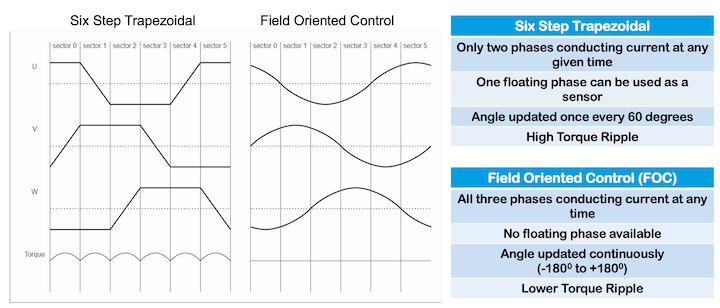
In any discussion of brushless motors, terms such as sinusoidal, trapezoidal and field-oriented control commonly appear. Understanding these terms is the first step to mastering the underlying concepts. The Design Summit video offers an overview of this topic, summarized briefly in this section. In a typical motor drive system with a battery or other DC source of power, a power stage delivers a three-phase AC current. As shown in Figure 1, the current driving of a BLDC or PMSM motor can be based on six-step trapezoidal control or field-oriented control.

Accurately determining the rotor position affects how efficiently the motor speed and torque can be controlled. The rotor position is determined by hardware sensors via a module that detects the motor angle and speed. In some designs, current and voltage values can also be used to determine motor position through microcontroller functions.
FOC_Figure_1.png

Figure 1. Difference between Trapezoidal and FOC

In designs that use trapezoidal control, the current is conducted only during two phases. During a floating phase, sensor readings are obtained. At this time, the values of the back electro-motive force (BEMF) can be monitored to deduce the rotor position. While BLDC motor designs typically have high torque ripple, this approach is simpler and less expensive to implement.

FOC implementations for PMSM motors conduct current in each of the three phases; each phase’s current, voltage and power are offset 120 degrees from the others. This minimizes the torque ripple. Motor angle updates are continuous. This sinusoidal control, primarily used for PMSM motors, requires more elaborate electronic monitoring and control circuitry. Control of an AC motor is essentially equivalent to controlling a DC motor using FOC.

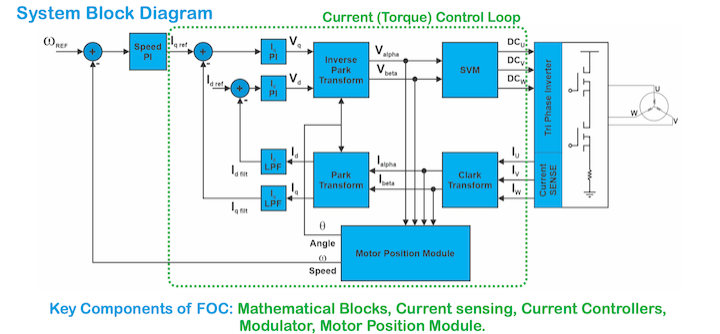
As shown in Figure 2, torque is monitored and controlled by a Current Control Loop. Feedback from a tri-phase inverter is fed to a current-sensing circuit and relayed to the control loop to maintain precise torque levels. A Motor Position Module samples voltage and current values to provide angle and speed levels of the motor through a series of transform operations.
 

FOC_Figure_2.png

Figure 2. Fundamental components in a FOC-based implementation.

The significant advances in motor control technology offer an array of opportunities for innovative product designs that capitalize on the efficiency, power handling and manageability of BLDC/PMSM motors. To learn more, go to Qorvo's power products page. 

Stay up to date with us.

Sign up for notification on new products, product/process change notifications (PCNs) and end of life (EOL) alerts.

Sign Up

Qorvo products are at work connecting, protecting and powering the planet. We bring core radio frequency (RF) and power technologies and solutions to automotive, consumer, defense & aerospace, industrial & enterprise, infrastructure and mobile markets.

Stay Connected

  • Facebook
  • X
  • LinkedIn
  • YouTube
  • Products
  • Solutions
  • Design Hub
  • New Products
  • Product Compliance
  • Blog Posts
  • Events & Trade Shows
  • News Releases
  • Success Stories
  • Technical Articles
  • About Us
  • Careers
  • Corporate Videos
  • Quality
  • Locations
  • Investors
  • How to Buy
  • Forums
  • Portals
  • Contact Us
  • Subscription Center
Site MapFeedbackLegalPrivacySupply Chain Transparency

© 2026 Qorvo US, Inc

|

+1-833-641-3810

Unlock the Full Potential of Tri-Phase Motor Innovation

July 27, 2023
 Field-Oriented Control of BLDC and PSMS Motors Draft 4_fmedit

Beyond Traditional Brush Motors

Brushless DC (BLDC) motors and permanent magnet synchronous motors (PMSMs) have become increasingly popular for many applications. Without brushes and commutators, they are more efficient than brushed motors, and they increase motor life. To eliminate the brushes and the commutator, these motors employ an electronically generated revolving magnetic field. This is accomplished by using external circuits to modulate the voltages and currents delivered to the phases.

Although these circuits add some complexity, BLDC motors and PMSMs offer major advantages over traditional brushed motors. Their electronic commutation schemes improve energy efficiency by 20 percent to 30 percent over brushed motors running at the same speed while being more durable, smaller, lighter and quieter.

Field-oriented control (FOC), a technique used to control PMSMs, provides superior performance in minimizing torque ripple and extending speed operating range. It’s becoming more popular and is starting to show up in higher-cost, higher-performance power tools and white goods. Embedded programming on a microcontroller (MCU) is a common choice to implement FOC-related features and functionality, plus satisfy each individual application requirement while optimizing the overall solution.

This blog post explores FOC-based BLDC/PMSM motor design, including an example of how to program a microcontroller chip to access and manage motor operation.

In any discussion of brushless motors, terms such as sinusoidal, trapezoidal and field-oriented control commonly appear. Understanding these terms is the first step to mastering the underlying concepts. The Design Summit video offers an overview of this topic, summarized briefly in this section. In a typical motor drive system with a battery or other DC source of power, a power stage delivers a three-phase AC current. As shown in Figure 1, the current driving of a BLDC or PMSM motor can be based on six-step trapezoidal control or field-oriented control.

Accurately determining the rotor position affects how efficiently the motor speed and torque can be controlled. The rotor position is determined by hardware sensors via a module that detects the motor angle and speed. In some designs, current and voltage values can also be used to determine motor position through microcontroller functions.

FOC_Figure_1.png

Figure 1. Difference between Trapezoidal and FOC

In designs that use trapezoidal control, the current is conducted only during two phases. During a floating phase, sensor readings are obtained. At this time, the values of the back electro-motive force (BEMF) can be monitored to deduce the rotor position. While BLDC motor designs typically have high torque ripple, this approach is simpler and less expensive to implement.

FOC implementations for PMSM motors conduct current in each of the three phases; each phase’s current, voltage and power are offset 120 degrees from the others. This minimizes the torque ripple. Motor angle updates are continuous. This sinusoidal control, primarily used for PMSM motors, requires more elaborate electronic monitoring and control circuitry. Control of an AC motor is essentially equivalent to controlling a DC motor using FOC.

As shown in Figure 2, torque is monitored and controlled by a Current Control Loop. Feedback from a tri-phase inverter is fed to a current-sensing circuit and relayed to the control loop to maintain precise torque levels. A Motor Position Module samples voltage and current values to provide angle and speed levels of the motor through a series of transform operations.


FOC_Figure_2.png

Figure 2. Fundamental components in a FOC-based implementation.

The significant advances in motor control technology offer an array of opportunities for innovative product designs that capitalize on the efficiency, power handling and manageability of BLDC/PMSM motors. To learn more, go to Qorvo's power products page. 

Stay up to date with us.

Sign up for notification on new products, product/process change notifications (PCNs) and end of life (EOL) alerts.

Sign Up

Qorvo products are at work connecting, protecting and powering the planet. We bring core radio frequency (RF) and power technologies and solutions to automotive, consumer, defense & aerospace, industrial & enterprise, infrastructure and mobile markets.

Stay Connected

  • Facebook
  • X
  • LinkedIn
  • YouTube
  • Products
  • Solutions
  • Design Hub
  • New Products
  • Product Compliance
  • Blog Posts
  • Events & Trade Shows
  • News Releases
  • Success Stories
  • Technical Articles
  • About Us
  • Careers
  • Corporate Videos
  • Quality
  • Locations
  • Investors
  • How to Buy
  • Forums
  • Portals
  • Contact Us
  • Subscription Center
Site MapFeedbackLegalPrivacySupply Chain Transparency

© 2026 Qorvo US, Inc

|

+1-833-641-3810

Qorvo
  • Products
  • Solutions
  • Design Hub
  • Support
  • About Us
Qorvo
Qorvo
Qorvo
  • Products
  • Solutions
  • Design Hub
  • Support
  • About Us
Qorvo
Qorvo