Noccela and Ultra-Wideband Take Industry and Sports to the Next Level

Qorvo Blog TeamJuly 12, 2022

Location-Based Services Get Even More Precise

The technologies behind location-based services continue to change how we work, play and stay in touch. GPS enabled an explosion of retail e-commerce with home delivery and allowed us to say goodbye to those big map books. Wi-Fi helped nail down location precision even further. And Bluetooth® technology literally opens doors in modern automobiles as owners approach within a few feet of their cars. But Ultra-Wideband (UWB) technology's centimeter-scale precision has enabled a level of location and communications unmatched by these previous technologies. UWB is the instrumental technology behind micro-location services offered by companies like Noccela, and it will continue to impact our lives in ways not yet imagined.

Noccela, a solution developer and micro-location services provider based in Finland, is a world leader in real-time location services (RTLS) built on UWB. Since 2015, they have been instrumental in:

  • Modernizing industrial operations
  • Enabling a higher level of sports analytics
  • Changing how retail businesses work
  • Keeping activities going while alerting people of Covid-19 exposure through high-precision and accurate contact tracing

Noccela_logo_278x55.png
Noccela has been a forerunner in deploying UWB for RTLS IoT since 2014 in demanding multi-floor environments. Both its software and hardware are designed in-house. Its positioning-as-a-service incorporates location data APIs and a workflow engine for process management. Noccela also provides end-to-end solutions for retail environments and contact tracing. Get more information at Noccela.com.

Noccela's latest generation of UWB technology utilizes its high-performance ranging (HPR) algorithm, which provides high levels of accuracy and supports massive tag counts, expansive coverage, long battery life and two-way communications. The company built its solution on Qorvo DW1000 UWB devices.

Digitalizing Industry

Noccela began research on micro-location technologies for industrial applications in 2014. Sub-meter to centimeter-scale micro-location is essential to digitalizing industrial operations through Industry 4.0, Smart Factory and lean initiatives. Process optimization and safety are the two prime considerations for most industries. Both become more informed through linking who, what, when and where to people, tools, supplies, goods and machinery—in real-time. After all, one of the best ways to improve efficiency is to understand where the bottlenecks are. The most efficient way to retrieve a misplaced tool, pallet or vehicle is to know exactly where it is. And the best way to keep workers and machinery at a safe distance from each other is to know precisely where both are at a millisecond in time. UWB-based micro-location delivers that information in real-time and allows systems to instantly measure, analyze and alert. This is Noccela's domain of expertise.

To build an industrial-scale solution, Noccela engineers researched both Bluetooth® low energy (LE) and UWB and discovered the limitations of Bluetooth LE for high-precision location capability—Bluetooth LE's received signal strength indicator (RSSI) methodology. The subjection to multi-path and interference from objects and metal machinery could not offer reliable, accurate ranging and location of objects in industrial and other environments. UWB could.
Ultra-Wideband for Dummies

Power Management Fundamentals For Dummies 

Download the E-Book

0-use-cases.png
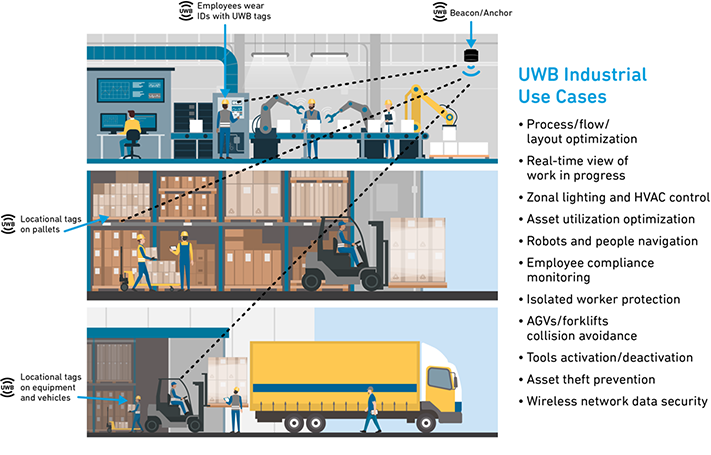
UWB-enabled sensors, tags and smart devices that identify and locate people and things, combined with other hardware and software platforms, allow companies and organizations to conduct multiple real-time location services. These include applications from monitoring employee safety to asset location and process/flow optimization, resulting in improved efficiencies, better compliance and cost savings.

How UWB Executes Such High Levels of Precision

UWB is impervious to the challenges of narrow-band Wi-Fi and Bluetooth LE for ranging and location. While communicating between anchors and tags, UWB radios use very low signaling energy spread over a greater bandwidth with much faster pulse rise and fall times than narrow-band signals.

Strategically placed anchors can report different ranges to a tagged object. The object can be located in two- and three-dimensional space with great accuracy knowing the anchors' precise locations.

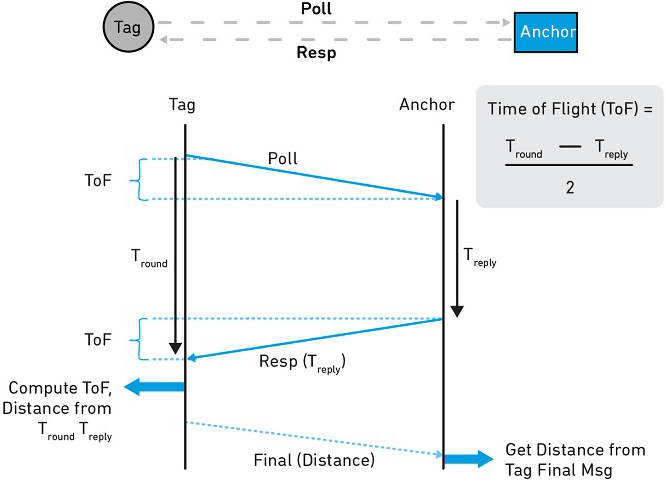
Two-way ranging (TWR) and time difference of arrival (TDoA) ranging methods eliminate the impacts that reflections from walls and machinery have on signal strength. Other ranging methodologies in UWB include phase difference of arrival (PDoA) and reversed TDoA (RTDoA), offering benefits for various types of deployments. See Figure 1.
1-time-of-flight.png
Figure 1: Secure two-way ranging between UWB tag and anchor.

Micro-location with Noccela

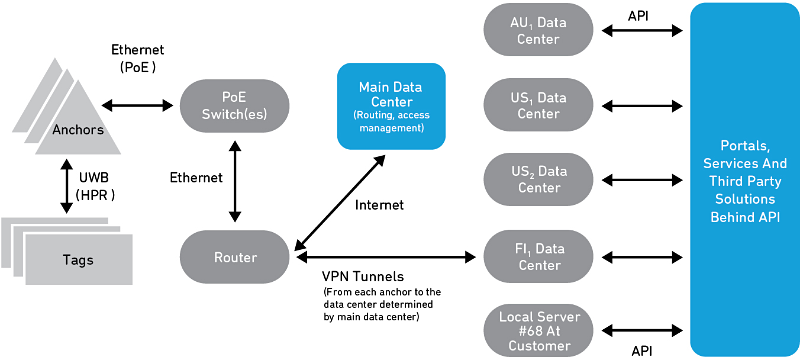
With Noccela's solution, anchors are gateways to the positioning engine that runs on-premises or in the cloud and stores positioning data in real-time. Anchors connect to the network through Ethernet cables or Wi-Fi. Once the anchors gain network connectivity, they establish VPN tunnels to the host running their designated positioning engine. The anchors feed data to the positioning engine, which controls the anchors and tags assigned to it. Data can be streamed in real-time through a constant connection or a requested connection when needed.

The positioning engine also automatically calibrates anchor positions, simplifying and accelerating installation. Powerful access point interfaces (APIs) enable connectivity to portals, services, and 3rd party solutions, such as streaming engines like Kafka, safety alerting systems, process optimization engines, and even complete digital twins. See Figure 2.
2-architecture.png

Figure 2: Noccela System Architecture

Object Tracking for the Win

Noccela's HPR is innovative, using TWR and TDoA methods to improve accuracy and reach. HPR can cover up to 500 square meters per anchor, requiring fewer anchors than other solutions while providing as fine as two-centimeter accuracy of objects moving at up to 60 km/h. This level of coverage and precision at high speeds is helpful in sports analytics, where Noccela solutions help athletic leagues take their competition to a new level.

A football (soccer in the U.S.) field is typically 105 meters by 68 meters. Sports stadiums often do not have a roof. This and the danger of objects colliding with anchors above a field make placement other than around the field impractical. Noccela's HPR solution covers a football field with 16 anchors, strategically placed around the field perimeter, and still delivers high, 3D positional accuracy.

Fewer anchors with greater accuracy give Noccela customers the precision they need at a lower cost than more complex UWB installations. And it makes deployment quick: many installations can often be completed in one or two days.

Noccela's solution offered a point-to-point tracking solution to upload close-contact data through a single anchor per team. The tracking software recorded the events with time stamps that the attendees (tags) were within 2 meters of proximity to each other at any time. If a case of the virus was reported among the team, managers would immediately know all potentially affected members and isolate them without shutting down an entire session.

Next-Generation HPR 2.0 Coming Soon

Noccela is a solution partner with Qorvo. While their initial solution was developed on Qorvo's DW1000 device, the company will introduce its HPR 2.0 technology using Qorvo DW3000 UWB ICs. Noccela's new generation solution will help keep the company competitive and positioned as an industry leader for micro-location services.

For more in-depth information about how UWB technology works, read the whitepaper, Getting Back to Basics with Ultra-Wideband (UWB).

The Bluetooth® word mark and logos are registered trademarks owned by Bluetooth SIG, Inc., and any use of such marks by Qorvo US, Inc. is under license. Other trademarks and trade names are those of their respective owners.

Stay up to date with us.

Sign up for notification on new products, product/process change notifications (PCNs) and end of life (EOL) alerts.

Sign Up

Qorvo products are at work connecting, protecting and powering the planet. We bring core radio frequency (RF) and power technologies and solutions to automotive, consumer, defense & aerospace, industrial & enterprise, infrastructure and mobile markets.

Stay Connected

  • Facebook
  • X
  • LinkedIn
  • YouTube
  • Products
  • Solutions
  • Design Hub
  • New Products
  • Product Compliance
  • Blog Posts
  • Events & Trade Shows
  • News Releases
  • Success Stories
  • Technical Articles
  • About Us
  • Careers
  • Corporate Videos
  • Quality
  • Locations
  • Investors
  • How to Buy
  • Forums
  • Portals
  • Contact Us
  • Subscription Center
Site MapFeedbackLegalPrivacySupply Chain Transparency

© 2026 Qorvo US, Inc

|

+1-833-641-3810

Noccela and Ultra-Wideband Take Industry and Sports to the Next Level

Qorvo Blog TeamJuly 12, 2022

Location-Based Services Get Even More Precise

The technologies behind location-based services continue to change how we work, play and stay in touch. GPS enabled an explosion of retail e-commerce with home delivery and allowed us to say goodbye to those big map books. Wi-Fi helped nail down location precision even further. And Bluetooth® technology literally opens doors in modern automobiles as owners approach within a few feet of their cars. But Ultra-Wideband (UWB) technology's centimeter-scale precision has enabled a level of location and communications unmatched by these previous technologies. UWB is the instrumental technology behind micro-location services offered by companies like Noccela, and it will continue to impact our lives in ways not yet imagined.

Noccela, a solution developer and micro-location services provider based in Finland, is a world leader in real-time location services (RTLS) built on UWB. Since 2015, they have been instrumental in:

  • Modernizing industrial operations
  • Enabling a higher level of sports analytics
  • Changing how retail businesses work
  • Keeping activities going while alerting people of Covid-19 exposure through high-precision and accurate contact tracing

Noccela_logo_278x55.png
Noccela has been a forerunner in deploying UWB for RTLS IoT since 2014 in demanding multi-floor environments. Both its software and hardware are designed in-house. Its positioning-as-a-service incorporates location data APIs and a workflow engine for process management. Noccela also provides end-to-end solutions for retail environments and contact tracing. Get more information at Noccela.com.

Noccela's latest generation of UWB technology utilizes its high-performance ranging (HPR) algorithm, which provides high levels of accuracy and supports massive tag counts, expansive coverage, long battery life and two-way communications. The company built its solution on Qorvo DW1000 UWB devices.

Digitalizing Industry

Noccela began research on micro-location technologies for industrial applications in 2014. Sub-meter to centimeter-scale micro-location is essential to digitalizing industrial operations through Industry 4.0, Smart Factory and lean initiatives. Process optimization and safety are the two prime considerations for most industries. Both become more informed through linking who, what, when and where to people, tools, supplies, goods and machinery—in real-time. After all, one of the best ways to improve efficiency is to understand where the bottlenecks are. The most efficient way to retrieve a misplaced tool, pallet or vehicle is to know exactly where it is. And the best way to keep workers and machinery at a safe distance from each other is to know precisely where both are at a millisecond in time. UWB-based micro-location delivers that information in real-time and allows systems to instantly measure, analyze and alert. This is Noccela's domain of expertise.

To build an industrial-scale solution, Noccela engineers researched both Bluetooth® low energy (LE) and UWB and discovered the limitations of Bluetooth LE for high-precision location capability—Bluetooth LE's received signal strength indicator (RSSI) methodology. The subjection to multi-path and interference from objects and metal machinery could not offer reliable, accurate ranging and location of objects in industrial and other environments. UWB could.

Ultra-Wideband for Dummies

Power Management Fundamentals For Dummies 

Download the E-Book

0-use-cases.png
UWB-enabled sensors, tags and smart devices that identify and locate people and things, combined with other hardware and software platforms, allow companies and organizations to conduct multiple real-time location services. These include applications from monitoring employee safety to asset location and process/flow optimization, resulting in improved efficiencies, better compliance and cost savings.

How UWB Executes Such High Levels of Precision

UWB is impervious to the challenges of narrow-band Wi-Fi and Bluetooth LE for ranging and location. While communicating between anchors and tags, UWB radios use very low signaling energy spread over a greater bandwidth with much faster pulse rise and fall times than narrow-band signals.

Strategically placed anchors can report different ranges to a tagged object. The object can be located in two- and three-dimensional space with great accuracy knowing the anchors' precise locations.

Two-way ranging (TWR) and time difference of arrival (TDoA) ranging methods eliminate the impacts that reflections from walls and machinery have on signal strength. Other ranging methodologies in UWB include phase difference of arrival (PDoA) and reversed TDoA (RTDoA), offering benefits for various types of deployments. See Figure 1.

1-time-of-flight.png
Figure 1: Secure two-way ranging between UWB tag and anchor.

Micro-location with Noccela

With Noccela's solution, anchors are gateways to the positioning engine that runs on-premises or in the cloud and stores positioning data in real-time. Anchors connect to the network through Ethernet cables or Wi-Fi. Once the anchors gain network connectivity, they establish VPN tunnels to the host running their designated positioning engine. The anchors feed data to the positioning engine, which controls the anchors and tags assigned to it. Data can be streamed in real-time through a constant connection or a requested connection when needed.

The positioning engine also automatically calibrates anchor positions, simplifying and accelerating installation. Powerful access point interfaces (APIs) enable connectivity to portals, services, and 3rd party solutions, such as streaming engines like Kafka, safety alerting systems, process optimization engines, and even complete digital twins. See Figure 2.

2-architecture.png

Figure 2: Noccela System Architecture

Object Tracking for the Win

Noccela's HPR is innovative, using TWR and TDoA methods to improve accuracy and reach. HPR can cover up to 500 square meters per anchor, requiring fewer anchors than other solutions while providing as fine as two-centimeter accuracy of objects moving at up to 60 km/h. This level of coverage and precision at high speeds is helpful in sports analytics, where Noccela solutions help athletic leagues take their competition to a new level.

A football (soccer in the U.S.) field is typically 105 meters by 68 meters. Sports stadiums often do not have a roof. This and the danger of objects colliding with anchors above a field make placement other than around the field impractical. Noccela's HPR solution covers a football field with 16 anchors, strategically placed around the field perimeter, and still delivers high, 3D positional accuracy.

Fewer anchors with greater accuracy give Noccela customers the precision they need at a lower cost than more complex UWB installations. And it makes deployment quick: many installations can often be completed in one or two days.

Noccela's solution offered a point-to-point tracking solution to upload close-contact data through a single anchor per team. The tracking software recorded the events with time stamps that the attendees (tags) were within 2 meters of proximity to each other at any time. If a case of the virus was reported among the team, managers would immediately know all potentially affected members and isolate them without shutting down an entire session.

Next-Generation HPR 2.0 Coming Soon

Noccela is a solution partner with Qorvo. While their initial solution was developed on Qorvo's DW1000 device, the company will introduce its HPR 2.0 technology using Qorvo DW3000 UWB ICs. Noccela's new generation solution will help keep the company competitive and positioned as an industry leader for micro-location services.

For more in-depth information about how UWB technology works, read the whitepaper, Getting Back to Basics with Ultra-Wideband (UWB).

The Bluetooth® word mark and logos are registered trademarks owned by Bluetooth SIG, Inc., and any use of such marks by Qorvo US, Inc. is under license. Other trademarks and trade names are those of their respective owners.

Stay up to date with us.

Sign up for notification on new products, product/process change notifications (PCNs) and end of life (EOL) alerts.

Sign Up

Qorvo products are at work connecting, protecting and powering the planet. We bring core radio frequency (RF) and power technologies and solutions to automotive, consumer, defense & aerospace, industrial & enterprise, infrastructure and mobile markets.

Stay Connected

  • Facebook
  • X
  • LinkedIn
  • YouTube
  • Products
  • Solutions
  • Design Hub
  • New Products
  • Product Compliance
  • Blog Posts
  • Events & Trade Shows
  • News Releases
  • Success Stories
  • Technical Articles
  • About Us
  • Careers
  • Corporate Videos
  • Quality
  • Locations
  • Investors
  • How to Buy
  • Forums
  • Portals
  • Contact Us
  • Subscription Center
Site MapFeedbackLegalPrivacySupply Chain Transparency

© 2026 Qorvo US, Inc

|

+1-833-641-3810

Qorvo
  • Products
  • Solutions
  • Design Hub
  • Support
  • About Us
Qorvo
Qorvo
Qorvo
  • Products
  • Solutions
  • Design Hub
  • Support
  • About Us
Qorvo
Qorvo