What Powers Artificial Intelligence Behind the Scenes?
Like it or not, artificial intelligence (AI) is transforming the way we work and live. Every day, AI platforms process billions of queries, helping users write code, analyze data, create content and solve complex problems. As AI becomes embedded in everything from healthcare and manufacturing to engineering and scientific research, demand continues to surge.
If you've used AI recently, you've probably had the same reaction as millions of others: amazement.
You type a question. Less than seconds later, a detailed answer appears. It feels almost mysterious—like watching a magician pull a rabbit from a hat. And instinctively, we ask: “How did they do that?”
What grabs AI headlines is the focus the visible side of the experience: the models, the chatbots, the image generators and the astonishing capabilities of large language models. But behind every AI interaction is something far less glamorous—and far more physically demanding.
Inside hyperscale data centers around the world, tens of thousands of servers are continuously processing, storing and moving vast amounts of information. GPUs train AI models around the clock. Enterprise solid-state drives (eSSDs) feed those processors with data at extraordinary speeds. High-performance networks move information across entire server farms in milliseconds.
And all of it depends on one critical resource: power.
Not just power, but intelligent, efficient and highly reliable power management. Because at AI scale, even small inefficiencies can have enormous consequences.
Take a Deeper Dive

- Peruse our Enterprise Solid State Solutions Guide
- Explore How Customizable PMICs Simplify Power Management System Design
- Read the technical article: Exploring Qorvo's Power Loss PRotection and Power Management One-Chip Solution for SSDs
The Power Challenge Behind AI
The challenge begins with speed. AI processors can perform staggering amounts of computation, but they are only as effective as the infrastructure supporting them. If storage cannot deliver data fast enough, expensive GPUs sit idle waiting for information. That's why enterprise SSDs have become a foundational element of modern AI infrastructure. They serve as the high-speed data pipeline that keeps AI workloads moving.
But performance is only part of the equation.
AI data centers consume tremendous amounts of electricity. Every server generates heat. Every watt matters. Even minor inefficiencies multiply across thousands of racks operating 24 hours a day. This is where Qorvo's technologies are helping shape the future of AI infrastructure.
The Power Grab
Qorvo's technologies do more than provide storage systems with stable power. They help enterprise SSDs operate under demanding workloads while consuming less energy and generating less heat.
One example is how Qorvo reimagined SSD power architecture. Traditionally, enterprise SSDs have treated power management as two separate functions. Power Management ICs (PMICs) regulate voltages, sequencing and efficiency, while Power Loss Protection (PLP) uses backup capacitors to preserve data during unexpected power interruptions.
However, Qorvo integrates both capabilities into a single, coordinated architecture. By combining PMIC and PLP functionality on one chip, SSD designers can reduce component count, shrink PCB footprint and simplify system design. The result is a more compact, efficient and reliable storage solution.
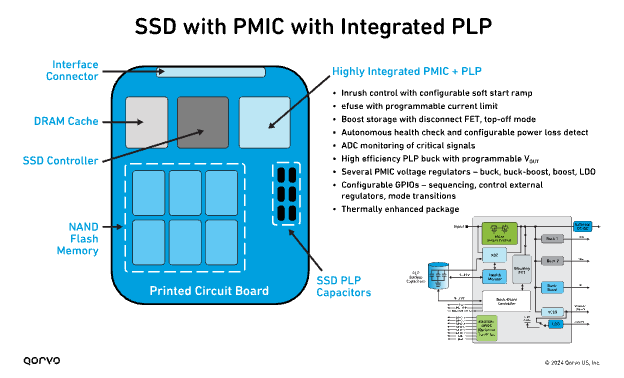
The benefits extend beyond board space. Fewer components reduce design complexity and manufacturing costs. Closer coordination between power management and power-loss protection enables faster response to power disruptions, helping safeguard data integrity while improving efficiency. For data centers deploying thousands of SSDs, these advantages can translate into higher storage density, lower energy consumption and reduced total cost of ownership.
The integration also helps address one of AI's growing challenges: physical scale. Data center operators want to pack more compute power and storage into the same footprint without dramatically increasing cooling requirements or power consumption. Highly integrated power architectures help make that possible by reducing component count and freeing valuable PCB space for additional storage capacity.
Don't Waste Your Energy
Reliability has become mission critical as AI workloads grow larger and more energy intensive.
AI training jobs often run continuously for days or even weeks. A sudden power interruption can corrupt data, halt processing or force workloads to restart from the beginning—wasting both time and substantial amounts of energy.
Qorvo's power-loss protection technologies help enterprise SSDs preserve critical data during unexpected power disruptions, helping maintain uptime, protect valuable computing resources and keep AI systems running efficiently.
he environmental implications matter as well. As AI adoption accelerates, concerns continue to grow around the energy consumption and cooling demands of hyperscale data centers. No single technology can solve this challenge alone, but improving efficiency across every layer of infrastructure can have a significant cumulative impact.
When millions of storage devices operate slightly cooler, slightly more efficiently and slightly more reliably, the results add up:
- Lower energy consumption
- Reduced cooling requirements
- Longer hardware lifespan
- Less electronic waste
- More sustainable infrastructure growth
That's the hidden reality behind modern AI.
The seemingly effortless experience users see on the surface is supported by a vast ecosystem of engineering innovation underneath—processors, networking, storage and power systems working together in real time.
While AI models may capture the headlines, it is the enabling technologies behind the scenes that help make the future of AI possible.
Want the backstories about RF technology? Explore our blog.
Ready to look under the hood? Discover our robust library of technical articles.