IUT Blagnac: Enabling Students to Create Next-Gen UWB Products
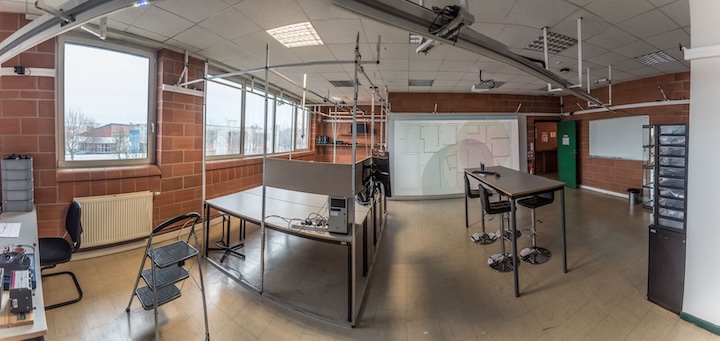
At the Institut Universitaire de Technologie (IUT) in Blagnac, France, a quiet revolution in ultra-wideband (UWB) education and applied research is taking place. What began as a technical challenge has grown into one of the most innovative UWB learning and experimentation environments in Europe—powered by curiosity, collaboration and a long-standing partnership with our company.
The Challenge: Turning Complex UWB Theory into Real-World Applications
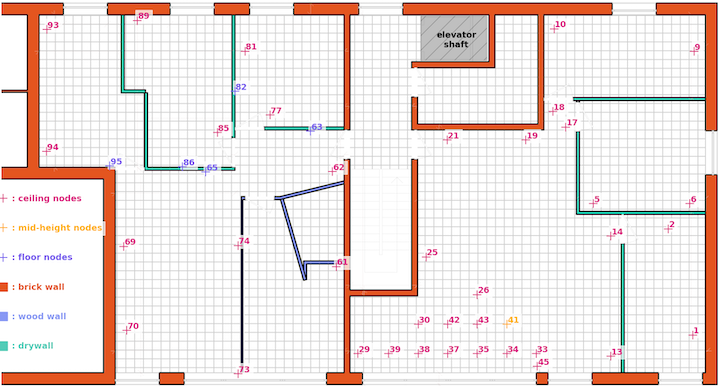
The test bed is deployed at a building scale, over the first floor of the building C of IUT Blagnac, using the DWM1001C.
The project began with what seemed like a narrow PhD challenge—accurately localizing UWB nodes that were constantly being nudged out of place—but it quickly revealed a much broader problem: how to test and validate UWB technology in unpredictable, real-world conditions. The IUT Blagnac team, led by Carine Livoti, Adrien Vonenbosch and Réjane Dalcet, lacked dedicated funding, relied on improvised equipment and needed environments that reflected genuine human movement and interference. They also faced the task of bridging academia and industry, providing hands-on training and translating cryptic localization data into insights people could use. As Réjane noted, the challenge was ultimately as human as it was technical.
“It’s about providing a service to people—testing how UWB can function in real environments, with real users.” — Réjane Dalcet
The Solution: A Multi-Facility UWB Test Bed Built on Partnership and Passion
With early support from our company—which provided access to UWB modules before the technology was widely available—the team began assembling a versatile, evolving test bed that now spans multiple facilities. In their research environment, UWB nodes operate in open areas, anechoic chambers and on rail or robotic systems for controlled experimentation, while building-scale deployments use DWM1001C modules to mirror real conditions. Their second site, a full smart-home environment, focuses on practical, human-centered applications such as locating lost items, supporting hospital asset tracking, and converting raw coordinates into natural-language outputs. This ecosystem transforms UWB from abstract theory into intuitive, meaningful and accessible innovation.
For more detail about this solution, read the blog post.