Smarter Power for Smarter Vision: Powering SoCs and AI Processors
From AI-powered doorbells to wearable health monitors and augmented reality glasses, machine vision has moved well beyond industrial automation. It’s now a core feature of many consumer electronics products, enhancing everyday life through intelligent detection and control. Vision-based AI is changing how we interact with our devices, whether it’s a smart lighting system that adjusts based on occupancy, a smart HVAC system that cools only the rooms that are in use or remote monitoring of patients’ vitals and health status.
According to Global Market Insights, the machine vision market reached $3.9 billion in recent years and is growing more than a 18% CAGR. As of the early 2020s, there were 9.76 billion IoT devices globally, producing over 64.2 zettabytes of data. These figures are expected to double and triple in the coming years, driving up both computational and power demands while device form factors continue to decrease.
A growing ecosystem of System-on-Chip (SoC) vendors is addressing these needs by developing compact, high-performance solutions for consumer and edge AI applications. Companies such as Synaptics and Ambarella are examples of suppliers building highly integrated SoCs that combine processing, memory, I/O and sensing functions to enable smaller, more capable devices.
SoCs further enable the proliferation of edge computing. Rather than sending data to the cloud for processing, edge devices analyze data locally—sometimes directly on the device or some other edge node—delivering benefits like reduced latency, improved privacy and real-time responsiveness. Gartner predicts, 75% of enterprise-generated data will be created and processed outside traditional data centers.
SoCs streamline performance in many ways, and they also present unique design challenges, particularly with power management.
Design Requirements for AI-enabled SoCs
Machine vision in edge devices typically involves capturing an image or video stream and analyzing it using an AI model for classification, detection or tracking. This requires not only high-performance processors, but also efficient, scalable power systems.
As AI models become more complex (e.g. gesture recognition, facial identification, real-time object tracking, spatial models), the computational load increases dramatically. Many vision processors consume between 0.5–1.5 Watts, but they rely on multiple voltage rails and require precise sequencing, burst-mode support and power gating to maximize efficiency, especially in devices that are primarily event-triggered. Advanced power management solutions are often implemented with energy consumption prediction models that can be used to turn off unused modules in tandem with battery health monitoring to enable low power modes, smart charging schedules and automatic shutdown conditions.
AI-enabled SoC devices have several critical power management requirements:
- They must support multi-rail configurations, sensors, memory, wireless modules and display or camera components.
- Power solutions must be able to handle burst-mode events—such as event-triggered AI inferences or rapid sensor activity—efficiently, without excessive voltage transients.
- Achieving low quiescent current during idle, sleep or low-power monitoring states is vital in maximizing battery life.
- These systems also require robust fault protection and strong thermal performance to ensure safe operation within compact, thermally constrained enclosures.
- The power solution must maintain a tiny physical footprint to fit inside wearables, handhelds and other space-limited designs—while still leaving room for the many peripherals modern SoC-enabled devices demand.
This is where Qorvo’s power expertise comes into play—introducing two PMICs purpose-built to support the performance, efficiency and integration demand of AI-enabled SoCs.
ACT88760 Features
The ACT88760 is a highly integrated PMIC purpose-built for compact, power-hungry applications like machine vision SoCs and edge AI processors. It delivers robust support for systems requiring multiple voltage rails, fast load response and ultra-low standby power—all in an exceptionally small footprint. Below is the block diagram followed by its key features.
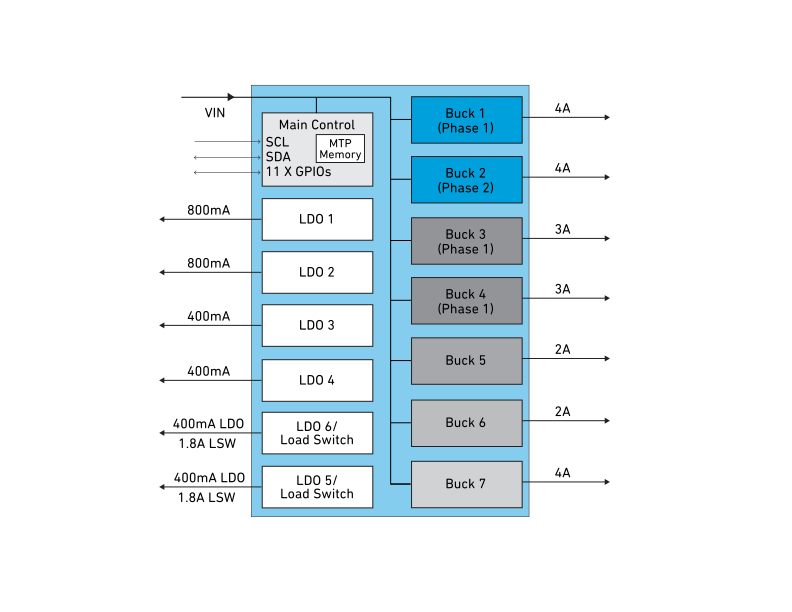
Designed for a 2.6 V to 5.8 V input range, ideal for single-cell Li-Ion or Li-Polymer batteries, the ACT88760 includes seven high-efficiency buck converters—three rated at 4 A, two at 3 A and two at 2 A—providing robust support for high-current components like AI processors and wireless modules. These are joined by six low-dropout regulators (LDOs), including two high-PSRR 800 mA LDOs ideal for noise-sensitive analog and RF circuits and four general-purpose 400 mA LDOs. Two of the LDOs can be reconfigured as 1.2 A load switches (LSWs) with low RDS(on), making them versatile enough for switching auxiliary loads. These rails support a wide output voltage range (0.5 V to 3.8 V), and the bucks can be paralleled in dual-phase mode to deliver up to 8 A, enabling reliable operation for high-current SoCs, AI accelerators and wireless modules. For designers working on burst-mode or event-triggered workloads, the PMIC’s 2.25 MHz switching frequency improves transient response while minimizing external component size.
In space-constrained, battery-powered devices, minimizing power loss is critical. The ACT88760 supports quiescent current as low as 10 µA with all regulators disabled and 65 µA in deep sleep with a single LDO active, ideal for “always-on” SoC-enabled systems.
The device features I²C programmability and up to 11 multifunction GPIOs for system-level control—ideal for dynamic voltage scaling, wake/sleep coordination and fault monitoring. Built-in protections include over-voltage protection (OVP), over-current protection (OCP), short-circuit protection (SCP) and thermal shutdown, making the ACT88760 well-suited for thermally constrained designs.
With its 3.78 mm x 3.78 mm WLCSP footprint and minimal external components, the ACT88760 is on average 40% smaller than comparable 13-rail PMICs. This significantly frees up board space for sensors, storage or larger batteries. For AI-enabled SoCs where every millimeter matters, the ACT88760 provides efficient, flexible and compact power management.
ACT88911 Features
The ACT88911 is another highly integrated PMIC that’s well suited for SoC-enabled devices. It is one of the highest rail-count commercially available PMICs designed to deliver versatile, efficient power management in applications such as computer vision, AI/AR/VR, FPGA and portable audio/video systems. It supports complex power requirements with a rich set of configurable regulators and advanced system control features—all within a compact 3.76 mm x 4.16 mm WLCSP package. Below is a block diagram followed by a description of its key features.
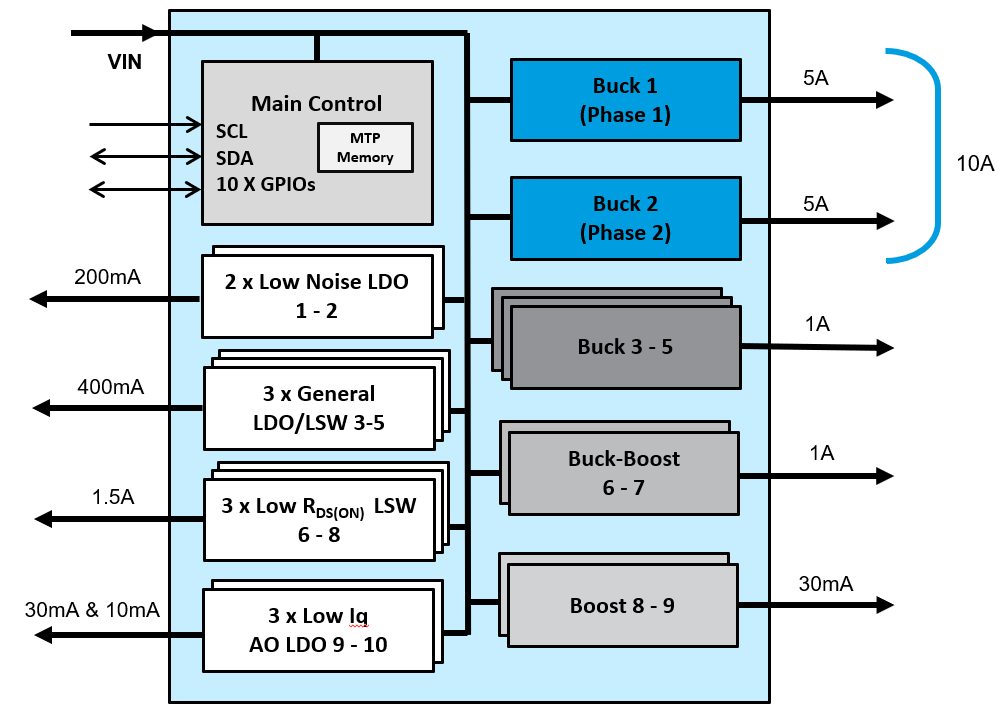
Operating over a wide input voltage range of 2.7 V to 5.5 V, the ACT88911 integrates five buck converters, two buck-boost converters, two boost regulators and ten LDOs/load switches—a total of 19 rails. The buck converters include two high-current 5 A rails (which can be paralleled for up to 10 A continuous output) and three 1 A rails, optimized for powering core SoC voltages with high efficiency and fast transient response. The two buck-boost regulators provide flexible voltage regulation above or below the input voltage, ideal for more dynamic SoC power. Additionally, two boost regulators support up to 30 mA output current with programmable voltage up to 20 V, enabling LED backlight or auxiliary power needs.
The LDOs and load switches cover a wide range of current capabilities, including two 200 mA high-PSRR LDOs for noise-sensitive analog and RF blocks, three 400mA general-purpose LDOs configurable as load switches, three 1.5A load switches for auxiliary loads and two ultra-low quiescent current always-on LDOs for standby or always-active SoC functions.
Designed for system-level flexibility, the ACT88911 features a comprehensive I²C interface for real-time configurability of output voltages, sequencing, dynamic voltage scaling (DVS) and fault management. Its 12 multifunction GPIOs support system control functions such as power good signaling, interruptions, LED driving with blink/breathe modes and wake-up triggers. The PMIC’s integrated master controller manages sophisticated power-up/power-down sequencing, sleep modes and fault monitoring, enabling SoC designers to optimize power states and ensure robust operation under varying workloads.
Efficiency is maximized through proprietary ACOT control for buck and buck-boost regulators, high switching frequencies (up to 3.3 MHz) for reduced external component size and low quiescent currents (down to ~10 µA in ultra-low power mode). These features help extend battery life and reduce thermal dissipation in compact, power-sensitive SoC devices.
Built-in protections including under-voltage lockout (UVLO), OVP, OCP, SCP and multi-level thermal warnings safeguard the SoC and system from fault conditions, enhancing reliability in demanding environments.
With their high integration, configurability and small footprints, both the ACT88760 and the ACT88911 enable SoC devices to achieve efficient, scalable power management for multi-rail systems, accelerating time to market and reducing overall system cost and complexity.
Conclusion
Machine vision is no longer a niche feature—it’s the central feature of the next wave of AI-enabled, battery-powered consumer technology. The challenge facing today’s designers is clear: how do you deliver increasingly sophisticated AI features in smaller, smarter and more mobile form factors? That’s where power management solutions like Qorvo’s ACT88760 and ACT88911 come in. These PMICs are purpose-built for edge devices that demand multi-rail power delivery, ultra-low standby power, dynamic workload support and a minimal footprint. Whether you’re building the next generation of smart glasses, home assistants or portable medical monitors, Qorvo offers the tools to help you power smarter.
Learn More
Visit qorvo.com to explore the ACT88760 or ACT88911 product pages, request samples or access technical resources for your next design.