Wideband RF in Electronic Warfare: Balancing Power, Bandwidth and Real-Time Performance
The core mission of electronic warfare (EW) hasn’t changed: control the all communications so your forces can operate, and your adversary cannot. What has changed is everything around it. Today’s EW systems operate across airborne, naval and ground platforms that are increasingly built around multifunction RF architectures, where radar, sensing and electronic support capabilities are integrated into a single system.
In addition, performance expectations continue to rise. As threats appear without warning and signals shift instantly, response time is no longer measured in seconds, but in microseconds. Systems must continuously sense, interpret and respond across the entire RF spectrum.
EW environments now require wide instantaneous bandwidth, high output power and stable operation under extreme conditions. Publicly acknowledged frequency ranges such as 6–18 GHz and 32–38 GHz highlight the breadth of spectrum these systems must cover, often extending even further in practice.
Wideband RF Design Challenges in EW Systems
Wideband EW design comes with distinct design challenges because of the need to make one RF chain behave well everywhere, all at once, across frequency, power levels and operating conditions.
EW receivers are designed to achieve high spurious-free dynamic range (SFDR), typically in the 90–110 dB range, enabling detection of weak signals in the presence of strong interferers. For example, a 6–18 GHz receiver with 500 MHz bandwidth and a ~5 dB noise figure yields a noise floor near −82 dBm, with minimum detectable signals around −72 dBm when accounting for detection margin. To meet these requirements, wideband low-noise amplifiers must maintain 2–3 dB Noise Figures with minimal Gain variation, while also delivering high linearity, often with Third-order Intercept Points near +30 dBm and compression points around +20 dBm, requiring careful matching, biasing and thermal design.

Here are the core challenges engineers must solve:
Gain Flatness Across Frequency
Maintaining Gain flatness across frequency is a key challenge in wideband EW design. Amplifiers inherently exhibit Gain variation over frequency, which becomes more pronounced as bandwidth increases, leading to uneven signal response and potential distortion. Addressing this requires carefully engineered matching networks and equalization techniques to stabilize performance across the operating range. In EW systems, inconsistent Gain can degrade signal fidelity, resulting in missed detections or reduced jamming effectiveness.
Linearity Over Wide Bandwidth
Maintaining linearity over wide bandwidths is another critical challenge in EW system design. Wideband signals often contain multiple simultaneous tones and complex modulations, increasing the likelihood of nonlinear behavior in RF components. This nonlinearity generates intermodulation distortion (IMD) and spectral regrowth, which can degrade overall system performance. In practice, distortion can mask weak signals, reduce the effectiveness of jamming operations and even interfere with friendly systems operating within the same spectral environment.
Efficiency vs. Bandwidth Tradeoffs
Balancing efficiency and bandwidth is a fundamental tradeoff in EW system design. High efficiency is typically easier to achieve in narrowband architectures, where components can be optimized for a specific frequency range. In contrast, wideband systems often sacrifice efficiency to maintain performance across a broader spectrum. This reduced efficiency leads to increased heat generation, larger power supply requirements and degraded size, weight and power (SWaP) performance, factors that directly impact system integration and operational effectiveness.
Output Power Consistency
Maintaining consistent output power across a wide frequency range is a significant challenge in EW system design. As frequency increases, device performance often begins to degrade, making it difficult to sustain high power levels across the entire operating band. This variability can impact overall system effectiveness, particularly in jamming applications where consistent power delivery across the spectrum is essential to ensure reliable threat suppression.
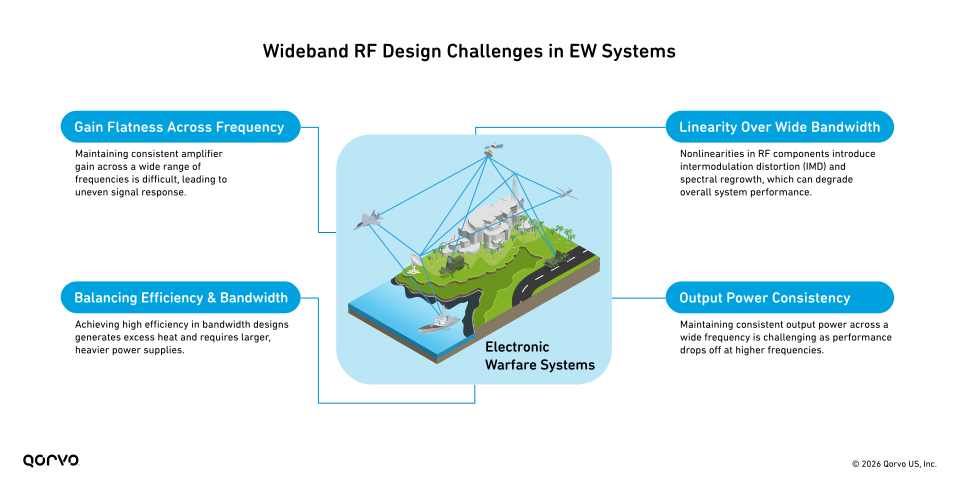
Wideband RF design in electronic warfare systems requires balancing gain, linearity, efficiency and output power across a broad, dynamic spectrum that will ensure consistent, reliable performance in real-time, mission-critical environments.
How to Address Wideband EW Challenges
Wideband EW architectures address core RF design challenges through a combination of solid-state technologies, optimized circuit design and system-level integration. Solid-state power amplifiers and carefully engineered RF front ends enable more predictable gain behavior across wide frequency ranges, while optimized matching networks and equalization techniques help minimize variation and ensure uniform signal amplification, which reduces the risk of missed detections or degraded jamming effectiveness. The inherent predictability of these devices also supports improved linearity, and when paired with optimized biasing and system-level design, helps reduce intermodulation distortion and spectral regrowth to preserve signal integrity in dense, multi-signal environments.
At the same time, solid-state solutions help manage the tradeoffs between efficiency and bandwidth by delivering improved Power-Added Efficiency (PAE) and more consistent performance across temperature and load conditions, reducing excess heat and supporting more SWaP-efficient designs. These architectures also enable more consistent output power across wide frequency ranges, particularly when implemented in modular form factors that allow power scaling without redesigning the entire transmit chain. On the receive side, wideband low-noise amplifiers and front-end limiters protect sensitive components while maintaining stable noise figure and gain, preserving detection capability across the spectrum. Finally, integrated RF modules simplify system design, reduce assembly complexity and improve repeatability, while the inherent reliability of solid-state architectures ensures consistent performance under sustained, mission-critical operating conditions.
Conclusion
Wideband EW design is a constant balancing act—maintaining gain, linearity, efficiency and stability across a broad and dynamic spectrum, often under high power and real-time operational constraints.
By aligning device technology, integration strategy and system design with the realities of wideband operation, engineers can overcome the core challenges of modern EW, and deliver predictable, high-performance capability across the electromagnetic spectrum.
For more information about our RF solutions for wideband, high-power systems, visit our EW solutions page. Additionally, you can find more interesting collateral on this subject by visiting our Qorvo Design Hub for a rich assortment of videos, technical articles, white papers, tools and more. For technical support, please visit Qorvo.com or reach out to Technical Support.